

The Startups That Scale Don't Just Have Good Accounting
By Dawn Hatch, Founding Partner, MATAX
Here is something I have noticed across the hundreds of startups we have worked with: the ones that scale without falling apart all have something in common. It is not just that their books are clean. It is that their entire operational core runs as a connected, intelligent system. One that gives them the right information when they need it, frees their team to focus on real work, and does not create a new bottleneck every time they add five people.
The ones that struggle? They usually have accounting covered. And that is where it ends.
Clean books are not the same thing as a well-run business. And a well-run business is what you actually need when you are scaling.
What Most Accounting Relationships Look Like
Your accounting firm gets your transactions. They categorize them, close the month, produce your financials, and send them over. Maybe two or three weeks after the month-end. You review them, note that things look roughly right, and move on.
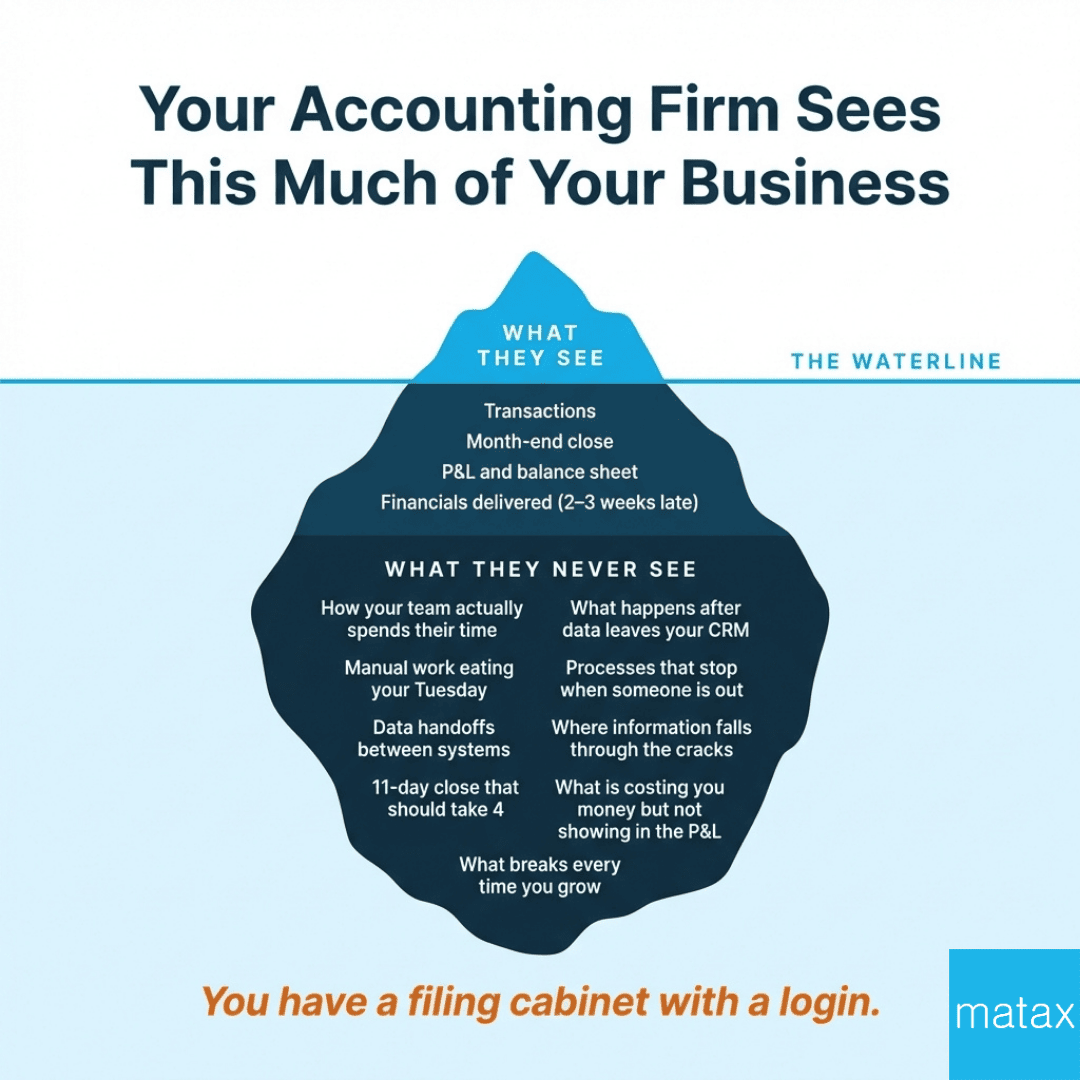
What they almost never see is everything else.
Such as how your team spends their time. What it actually takes to get information from point A to point B inside your company.
Which manual processes are eating up your operations coordinator's entire Tuesday? Why does your month-end close take eleven days when it should take four? What happens to data after it leaves your CRM? Where things fall through the cracks when your best person is out sick.
None of that shows up in your P&L, but all of it is costing you money, slowing you down, and quietly making your company harder to run every time you grow.
This is the gap most founders hit somewhere between 10 and 30 employees. The systems that worked when you were small start showing their limits. And the firm handling your books is still just handling your books.
You do not have a real operational foundation. You have a filing cabinet with a login.
What You Actually Need When You Are Scaling
There is a better way to think about this. We call it CoreOps.
CoreOps is the operational core of your business. It is what most people still call "the back office," but that name has not been accurate for a while. The old back office was reactive. It recorded what already happened.
CoreOps is different. It tells you what is happening right now, what is coming next, and what your team should focus on today.
It is not a department. It is a layer of intelligence that powers every decision your company makes.
Scaling a company cleanly requires someone who can look at the whole picture. Not just your chart of accounts. Your entire business. How information moves through every department, where data gets stuck, where it gets re-entered manually into a second system, and where it disappears entirely.
What tools you use, how they connect, and whether those connections actually work. What your people are doing that a well-built workflow automation could handle without anyone touching it.
That is a very different mandate than handling your books.
When we start working with a new client, we spend serious time learning their business before we build anything. We map their workflows end-to-end. We talk to the people doing the work, not just the founders.
We review every tool in their stack. We find the repetitive tasks no one questions anymore because they have always been done that way. We find the reports that take four hours to produce each week because no one ever built a better process.
That assessment almost always surfaces the same problems. Systems that do not communicate with each other. Data moving by hand between platforms. A team spending hours every week on work that should not require a human at all.
Once we understand what is actually happening, we build what should happen instead.
Building CoreOps: The Infrastructure That Works for Your Whole Company
The CoreOps framework has five connected layers. Each one serves a distinct function. Together, they form a single, integrated operational system.
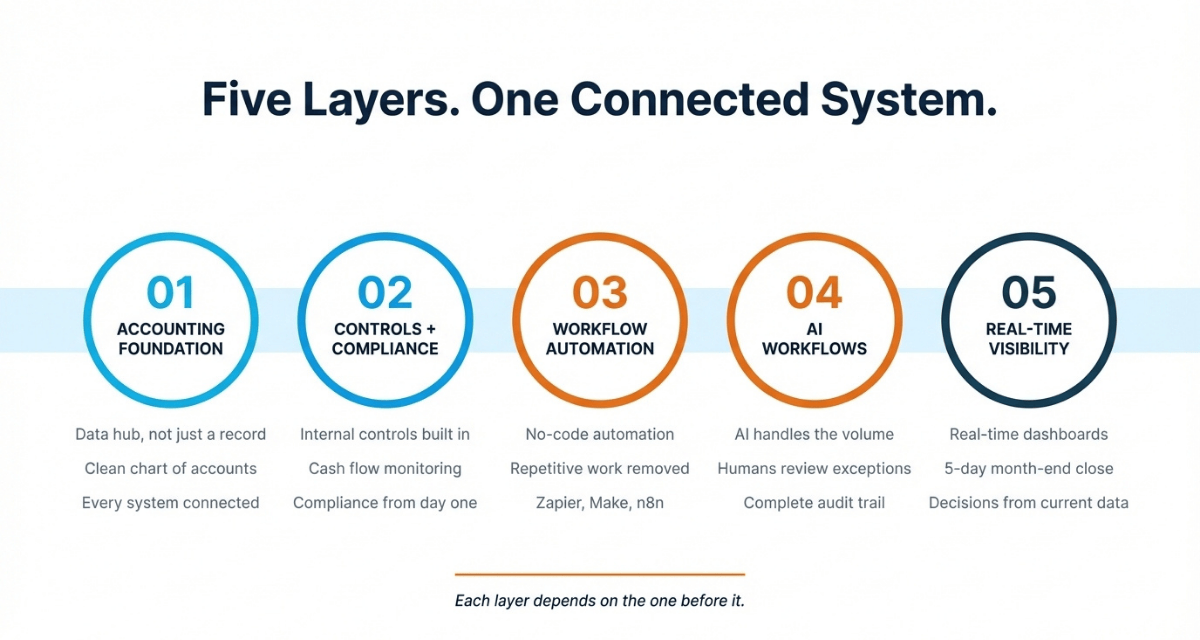
Your accounting foundation, built as the hub. This is where we start. Your accounting system is not just a record-keeping tool. It is the data hub that feeds accurate information to every system that needs it. When it is set up correctly, everything downstream works. When it is not, nothing does.
Your chart of accounts should reflect how your business actually makes and spends money, not just satisfy a default template someone set up on day one. Your bank feeds need to reconcile cleanly. Your revenue recognition needs to be solid enough to survive due diligence. And everything needs to connect properly to the other tools your company runs on.
For SaaS startups, where subscription data needs to flow cleanly between your product platform, billing tools, and accounting system, this connection is what makes everything else possible. When the accounting foundation is built correctly, it acts as the data hub that feeds accurate information to every system that depends on it. When it is not, you end up with reconciliation problems, reporting gaps, and integrations that never quite work the way they should.
Controls and compliance, built in from day one. This is the layer most founders underestimate until something goes wrong.
Internal controls, compliance management, and risk mitigation built into the accounting infrastructure from the start rather than bolted on as an afterthought. Companies that build controls early move faster, raise more confidently, and spend far less time on problems that should never have reached the crisis stage.
Payroll tax compliance, spend oversight, cash flow monitoring, fraud risk identification: these are not afterthoughts. They are part of the foundation.
Automation that handles the repetitive work. Once your workflows are mapped, you can identify every process that should not require a human to execute it every time. Invoice processing, expense categorization, bank reconciliation, report generation, data syncing between platforms, follow-up sequences, status updates, alerts when something needs attention.
We build these automations using no-code tools like Zapier, Make, and n8n, tailored specifically to how your business works. Not from a generic template.
For e-commerce businesses, that means order data, fulfillment updates, and revenue figures flow automatically into your accounting system without anyone touching them.
For SaaS companies, subscription events, upgrades, and churn data sync into Xero in real time. If your team runs on Slack, Slack automation can surface alerts and approvals right in the channels where they are already working.
The goal is not to eliminate your team. It is to give them their time back. The hours spent copying data from one system to another, reformatting the same report every month, chasing down information that should already be in one accessible place: those hours add up fast. When automation handles the repetitive work, your team can focus on the work that actually requires their skills and judgment.
AI that handles the complex stuff. This is where CoreOps gets genuinely exciting. AI agents can now process vendor invoices, categorize transactions, reconcile accounts, and flag anomalies, all without a human in the loop until the review stage.
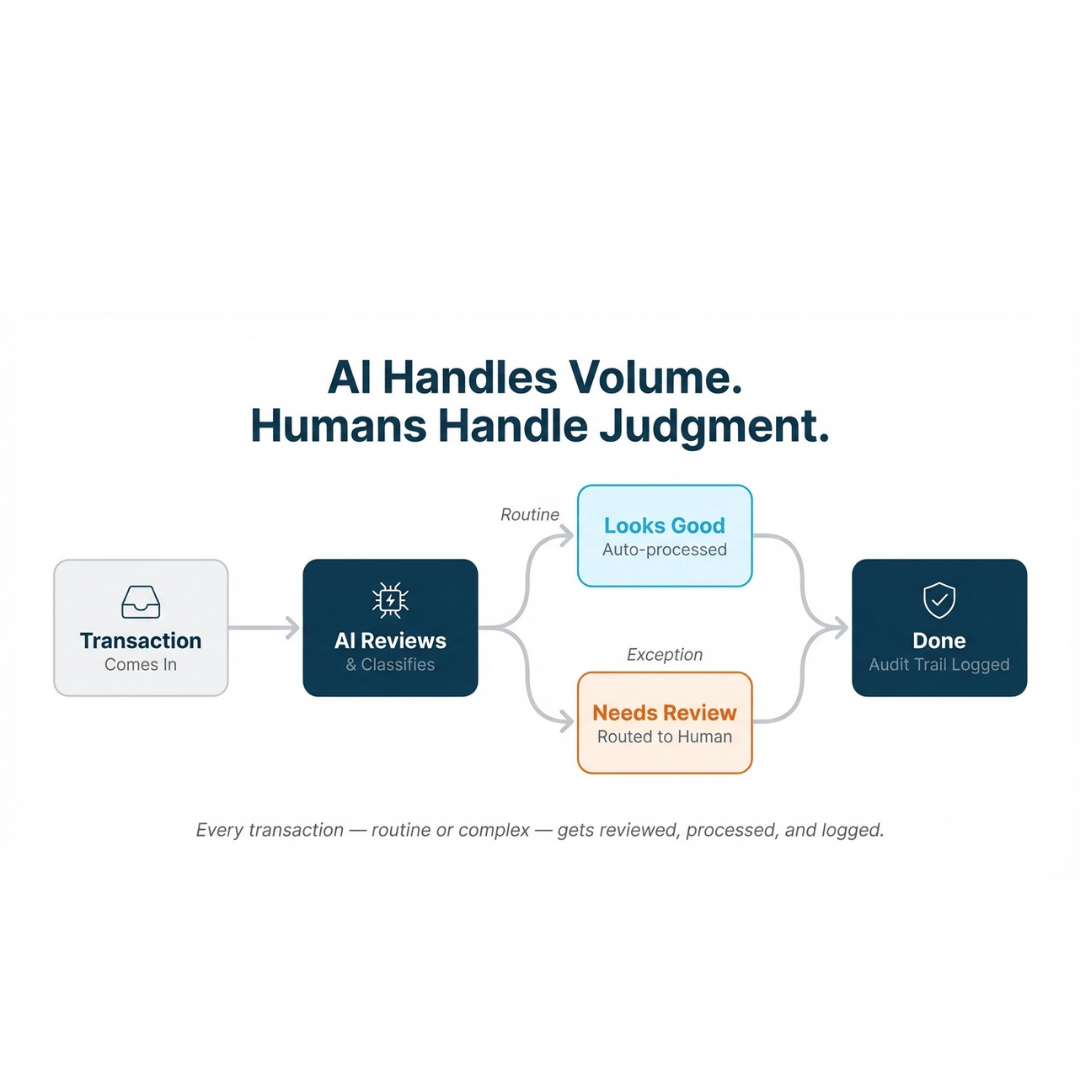
AI can monitor your key metrics and surface problems before they become expensive surprises. It can build your management reports and deliver them without anyone spending Friday afternoon in a spreadsheet.
Here is the part that matters most about how we build AI-powered workflows: every one of them keeps your team in the loop at the right points. This is human-in-the-loop automation by design. The AI handles the volume, the routine, and the initial processing.
Your people review, approve, and make the judgment calls. When something falls outside normal parameters, exception handling routes it to the right person automatically rather than letting it slip through. You always have a complete audit trail of what was processed, who reviewed it, and what decisions were made.
Automate without losing control is not a slogan. It is the actual design principle behind everything we build.
Real-time visibility that changes how you operate. One of the most consistent frustrations we hear from business leaders is some version of: "I don't really know where we stand until three weeks after the month closes." By which point, you are already in the next month, making decisions based on information that is six weeks old.
When the CoreOps layer is built correctly, you do not have to wait. Your key figures, cash position, revenue trends, pipeline health, and cost structure are all visible and up to date.
Your leadership team makes decisions from the same data. You spot problems early enough to do something about them. Your month-end close takes five business days or fewer, not eleven. You stop managing by looking backward.
Why This Is Now Possible for Startups at Every Stage
I want to be direct about something. The reason this matters so much right now is that the tools have finally caught up to the vision.
Five years ago, building what I am describing was possible, but it was expensive. It required custom development, enterprise-grade platforms, and teams large enough to manage complex systems. Most startups could not afford it. They made do with disconnected tools and manual workarounds, and that was the reasonable choice at the time.
That has fundamentally changed. Cloud accounting platforms have matured.
No-code automation tools like Zapier, Make, and n8n can connect practically any system to any other system. AI agents handle tasks that used to require hours of human processing time. And the cost of all of this has dropped to a point where a 15-person startup can build operational infrastructure that was only available to much larger companies a few years ago.
What most founders are missing is not budget or technology. It is someone who understands accounting, automation and AI at a deep enough level to connect them into a single operational layer that actually works.
You need someone who knows how a chart of accounts should be structured, how to build an n8n workflow, and how to design an AI agent with proper exception routing. That combination is rare. But it is exactly what CoreOps demands.
What CoreOps Does for Your Team
Something worth saying directly: a well-built CoreOps layer makes your team better at their jobs.
Nobody joined your company to spend their days copying data between systems or manually producing reports that could generate themselves. When you fix the operational layer, your team gets their time back.
Your accountant spends more time on analysis and less on data entry. Your ops lead improves processes instead of just executing them. Your executives think about next quarter instead of piecing together what happened last month.
Better systems do not replace your people. They elevate them.
And a well-built CoreOps layer also protects you as you grow. Payroll errors, vendor fraud, compliance gaps, cash flow surprises: these risks get bigger and more expensive at scale. The internal controls that catch them should be built into your CoreOps from the start. Founders who prioritize this early move faster, raise more confidently, and spend far less time firefighting.
How to Know If You Need CoreOps
Here are the signals we look for. If three or more of these describe your company, your CoreOps infrastructure needs attention.
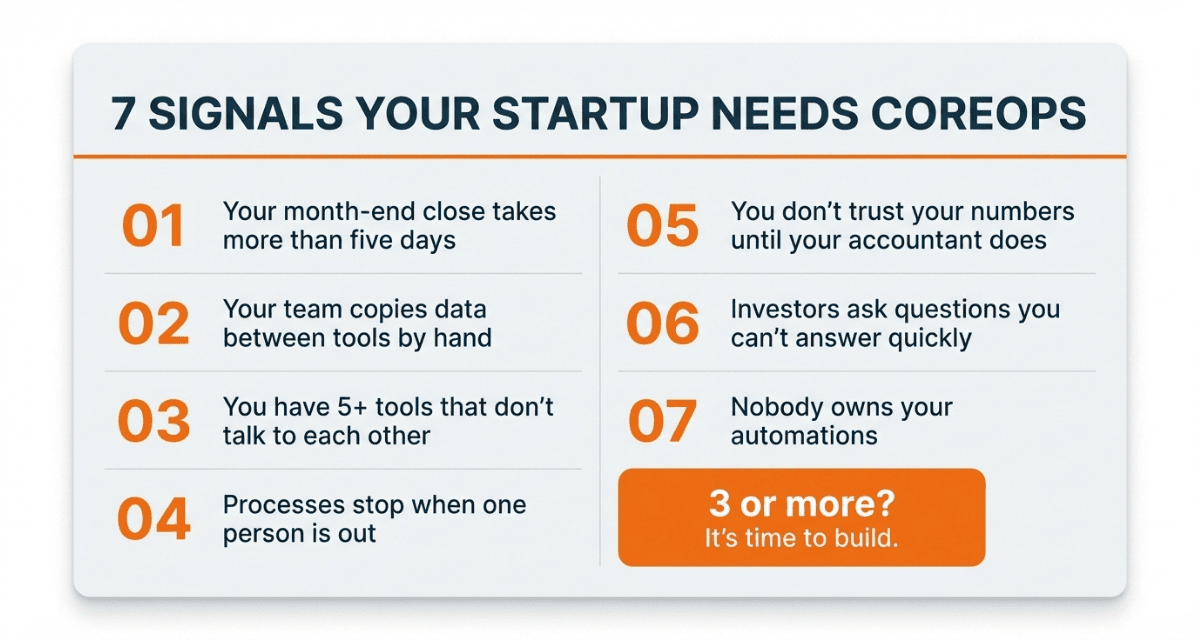
Your month-end close takes more than five business days. Your team spends measurable time each week copying data from one system to another. You have more than five tools that your team uses daily, and most of them are not connected to each other.
When a key team member is out, certain processes just stop. You do not trust your numbers until your accountant reviews them, which happens weeks after the fact.
Your board or investors ask questions you cannot answer quickly because the data lives in different places. You have automated a few things, but nobody really owns or maintains those automations.
If this sounds familiar, you are not behind. You are at the exact point where building a real CoreOps layer will have the biggest impact.
What Building CoreOps Actually Requires
It is worth being honest about what this takes, because a lot of founders assume any tech-savvy accountant or any automation consultant can pull it together. In practice, CoreOps sits at the crossroads of three fields. These fields rarely run deep in the same person or team. They are accounting basics, automation architecture, and AI workflow design.
If the accounting foundation is not structured correctly, your automations will move bad data faster. If the automations are not built around how your business actually works, they will break every time something changes. If the AI layer lacks strong exception handling and audit trails, you lose control and visibility.
These were the reasons the investment made sense in the first place.
The assessment phase matters more than most founders expect. Understanding how information actually moves through your company, where it gets stuck, where humans are doing work that should not require a human, takes real time and real curiosity. Skipping that step and going straight to building will almost always miss the things that matter most.
The other thing worth knowing: CoreOps should create infrastructure your team owns and understands. It should not be a black box that only one person can maintain. Every workflow should be documented. Your team should be trained on what is running and why. The systems should make your people more capable, not more dependent.
The Pattern We Keep Seeing
After working with hundreds of startup founders across SaaS, e-commerce, and technology, we can tell you that the ones who build their CoreOps layer early tend to share a similar experience on the other side. They know their numbers without asking anyone.
Their team focuses on work that moves the company forward. Their month-end close is not a recurring emergency. When an investor asks a hard question about operations, they have a real answer ready.
The founders who delay it have the opposite experience. They are still chasing information.
Their team is overwhelmed by manual work. Every new hire makes the operational complexity slightly worse because the systems were not built to scale. When a funding conversation comes up, they are scrambling to get their house in order instead of telling a clear story about a well-run business.
The difference is not intelligence or luck. It is CoreOps. It is the decision to treat the operational core of your business as what it actually is: the foundation that everything else depends on.
Stop calling it a back office. Start building your CoreOps.
Dawn Hatch is Founding Partner at MATAX, where she works with startup founders building the operational infrastructure that lets growing companies actually grow. She writes about CoreOps, startup operations, and the systems that turn operational chaos into clarity. Connect with her on LinkedIn.
Frequently Asked Questions
What is CoreOps, and how is it different from regular accounting?
CoreOps is the full operational core of your business. Regular accounting records what already happened. CoreOps connects your accounting foundation to your workflows, automations, and real-time reporting so your business has a living, intelligent operational layer rather than a filing system that gets updated once a month.
Think of it this way: accounting tells you what happened last month. CoreOps tells you what is happening right now and what needs your attention today.
My books are clean and my accountant is solid. Why would I need CoreOps?
Clean books are a great foundation. They are not a complete operational system. What your accountant almost never sees is how information moves through your company, which processes are eating your team's time, where data gets re-entered manually between platforms, and what falls through the cracks when someone is out sick.
CoreOps addresses all of that. It takes your accounting foundation and connects it to the rest of how your business actually operates. The gap between "good accounting" and "a well-run business" is exactly where CoreOps lives.
When is the right time for a startup to build a CoreOps layer?
The signal we see most consistently is somewhere between 10 and 30 employees. That is typically when the informal systems that worked in the early days start showing their limits. Month-end close starts taking longer than it should. Your team is spending hours on manual work that should be automated. You cannot get a clear answer quickly when someone asks a straightforward question about your numbers.
If three or more of the signals in this post describe your company, you are at the right moment to build it. Earlier is better. The founders who build their CoreOps layer before the chaos hits move through growth stages much more cleanly than the ones who wait until something breaks.
What tools does CoreOps use?
It depends on how your business is set up, which is exactly why we spend time in the assessment phase before recommending anything. That said, a typical CoreOps stack includes a cloud accounting platform like Xero or QuickBooks Online, no-code automation tools like Zapier, Make, or n8n to connect your systems, and AI agents for high-volume tasks like transaction processing and report generation.
The tools are not the hard part. The hard part is connecting them correctly around how your specific business works. A generic automation template will break every time something in your business changes. A CoreOps build that is designed around your actual workflows holds up as you grow.
Is this only for SaaS startups?
No. CoreOps applies to any startup that operates with multiple tools, a team of more than a few people, and a need for accurate, timely information to make decisions. We work with SaaS companies, e-commerce businesses, technology companies, and professional services firms, among others.
The specific automations and integrations look different depending on your business model. The underlying framework is the same: accounting foundation, controls and compliance, workflow automation, AI workflows, and real-time visibility.
What does the assessment phase actually involve?
Before we build anything, we spend real time learning how your business works. We map your workflows end to end. We talk to the people doing the work, not just the founders. We review every tool in your stack. We find the repetitive tasks no one questions anymore because they have always been done that way. We find the reports that take hours to produce each week because nobody ever built a better process.
That assessment almost always surfaces the same patterns: systems that do not communicate with each other, data moving by hand between platforms, and a team spending time on work that should not require a human. Understanding all of that before we build anything is what makes the difference between a CoreOps layer that actually works and one that creates new problems.
Will my team need to learn a bunch of new tools?
Your team will be trained on everything that gets built. That is a non-negotiable part of how we work. CoreOps should produce infrastructure your team owns and understands, not a black box that only one person knows how to maintain.
In practice, most of what we build runs in the background. Your team benefits from the output, such as faster reporting, fewer manual tasks, and cleaner data, without having to manage the underlying system day to day. Where your team does need to interact with new workflows, we document everything and build in the training before we hand anything over.
How is AI used in CoreOps, and does it replace my team?
AI in CoreOps handles volume, routine processing, and initial review. Vendor invoices, transaction categorization, account reconciliation, anomaly detection, and report generation: tasks that used to require hours of human time can run automatically without anyone in the loop until the review stage.
But every AI workflow we build keeps your team in the loop at the right points. This is human-in-the-loop automation by design. The AI handles the repetitive work. Your people review, approve, and make judgment calls. When something falls outside normal parameters, it routes to the right person automatically rather than slipping through. You always have a complete audit trail.
The goal is not to replace your team. It is to give them their time back and let them focus on work that actually requires their skills.
How long does a CoreOps build take?
It depends on the complexity of your current stack, the number of workflows we are automating, and how much of your accounting foundation needs to be rebuilt first. A solid assessment phase followed by a phased build is the right approach for most startups. Trying to change everything at once creates disruption; doing it in a logical sequence means each layer supports the next.
We can give you a much clearer timeline once we have done the assessment. That step is not skippable, and it is what makes the rest of the build predictable.
What is the difference between CoreOps and hiring a fractional CFO?
A fractional CFO focuses primarily on strategy, forecasting, and investor relations. CoreOps is the operational infrastructure layer underneath that work. The two are complementary, not competing. In fact, a fractional CFO with a well-built CoreOps layer underneath them can do significantly better work because the data they need is current, reliable, and accessible.
If you have a fractional CFO who is spending time chasing down information or working with numbers that are three weeks old, that is a CoreOps problem as much as anything else.
Have a question that is not covered here? Reach out to the MATAX team.
