

How to Automate Month-End Close at a SaaS Startup
Most seed-stage SaaS startups close their books in 8 to 10 business days. The top 10 percent close in 1 to 2. The gap is not headcount, revenue, or talent. It comes down to five sequencing decisions that change almost everything.
Here is what we tell founders when they ask. If your close feels like a monthly fire drill, you are not alone. Most SaaS startups we work with come in at 8 to 10 business days when we first meet. Some are pushing 14. The teams getting it done in 1 to 2 days are not working harder. Their work is set up differently.
This applies whether you are pre-revenue and tracking expenses against grant funds or seed capital, or post-revenue and managing a growing book of subscriptions. The mechanics of a clean close are the same at both ends.
That is actually good news. Setup is fixable. You do not need to hire a bigger team or buy a new system. You need the five shifts below, in the right order. Most founders we work with get to a 4-day close within a quarter of making these changes.
What does a 10-day close look like compared to a 4-day close?
This table shows the same SaaS startup, before and after the five shifts.
What runs the close The 10-day close (manual) The 4-day close (automated) Recurring journal entries Posted manually on day 1 of close Auto-posted on the last day of the prior month Bank reconciliation 4 to 6 hours of line-by-line matching 30 to 60 minute review of pre-matched items Accounts payable 2 to 3 days of receipt chasing and coding Daily review; runs on autopilot Revenue recognition Spreadsheet calculations across days 30-minute review of automated journals Close checklist Lives in one person's head or a Slack thread Single source of truth with auto-triggered handoffs Controller hours per cycle 60 to 80 hours 20 to 25 hours Statements to leadership Day 10 to day 14 Day 4 to day 6 The difference between these two columns is not money. It is sequencing.
What needs to be true before you start?
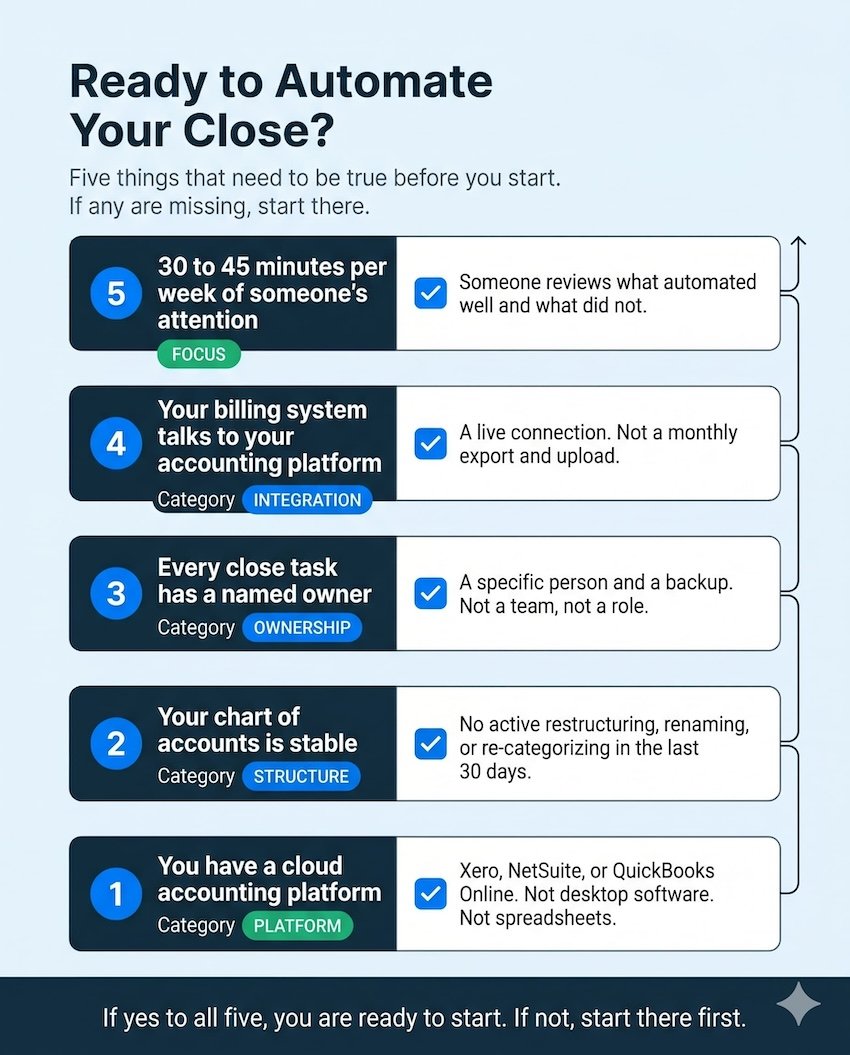
Five things need to be in place first. If any are missing, start there.
You have a cloud accounting platform. Xero, NetSuite, or QuickBooks Online. Desktop software and spreadsheet ledgers cannot connect to the automation below. We have been a 100 percent Xero firm since 2012, so I will reference Xero throughout. The principles apply to any cloud accounting platform.
Your chart of accounts is stable. If you are still renaming accounts, splitting costs across new departments, or restructuring revenue lines, pause automation until the structure holds. Automating on top of a moving target just locks in the chaos.
Every close task has a named owner. Not a department. A named person with a named backup. If month-end close currently lives in one controller's head, the first step is getting it on paper.
Your billing system talks to your accounting platform. Stripe has a direct Xero integration. Chargebee connects through automation tools. Ecommerce SaaS companies can use A2X. If billing is disconnected from accounting, your revenue numbers depend on manual data entry, and that is where most SaaS closes fall apart.
You have 30 to 45 minutes per week of someone's focus. Automation is not set-and-forget, especially in the first quarter. Someone needs to review what the system caught, refine the rules, and notice what is not working yet.
Most founders we work with start from this same place. You are not behind. You are right on time.
How should you pre-stage recurring entries before month-end?
The fastest gains come from work that happens before the month even ends. Most SaaS startups burn 1 to 2 days per close on entries that are completely predictable. Rent. Payroll accruals. Software subscriptions. Deferred revenue releases. Prepaid amortizations. None of these are surprises.
Set them up as recurring journal entry templates inside Xero. Assign the dates. Let them post automatically on the last day of the month, with a quick review built in rather than full approval needed. Your controller reviews the oddities, not every line.
For SaaS entries like deferred revenue, connect your billing platform directly. Stripe plugs straight into Xero with a native connection. For Chargebee or ProfitWell, route through a no-code tool like Zapier or Make. When the first of the month arrives, 60 to 70 percent of your entries are already posted.
What this buys you: 1 to 2 days off your close, starting with the very first cycle.
How do you automate bank and credit card reconciliation in Xero?
Manual line-by-line reconciliation is the single biggest time sink in a slow close. Modern matching inside Xero turns a 4-hour task into a 15-minute review. If you are only doing one thing from this list, do this one.
Start by building bank rules for your top 20 recurring transactions. AWS. Payroll. Rent. Your top five vendor payments. Subscription tools. These happen the same way every month. Xero matches them automatically the moment the bank feed lands.
For everything else, use Xero's suggested matches. The engine gets smarter with every cycle. After three months, most of the SaaS startups we work with see 85 to 95 percent of transactions matching automatically. The remaining 5 to 15 percent is where your judgment actually matters.
One more thing. Run reconciliation weekly, not monthly. Weekly reviews take 15 minutes each and eliminate the end-of-month scramble entirely.
What this buys you: bank reconciliation drops from a full day to 30 to 60 minutes of review per close.
How do you automate accounts payable for a SaaS startup?
AP is the messiest part of most SaaS closes. Receipts sit in inboxes. Invoices get forwarded to Slack and never coded. Bills arrive from 40 vendors in 12 different formats. I have watched brilliant founders and finance teams drown in this every single month.
Set up Hubdoc, free with Xero, or a similar tool. Give vendors one email address that forwards everything to Hubdoc automatically. AI extracts the date, amount, vendor, and category. Your bookkeeper reviews and posts.
For repeat vendors, let Hubdoc code automatically based on how you handled them last time. For new vendors, build an approval workflow in Xero so the right person signs off before anything hits the books.
If your team uses credit cards a lot, pair Hubdoc with Ramp or Brex. Both push transactions and receipts directly into Xero with the coding already applied. A 2026 study from Zenskar found that automated matching of purchase orders, invoices, and receipts shrinks AP processing time by up to 75 percent.
What this buys you: AP stops being a three-day month-end sprint and becomes a short daily review that mostly runs itself.
How do you handle SaaS revenue recognition without spreadsheets?
Revenue recognition is where SaaS closes break the hardest. In plain language: you need to record revenue when the work is done, not when the money arrives. That is what ASC 606 requires. For a SaaS company with annual contracts, monthly renewals, partial-month upgrades, and hundreds of subscriptions, you cannot do this math in a spreadsheet and stay sane.
Connect your billing platform directly to Xero, and let the billing system handle the deferred revenue schedule. Stripe, Chargebee, Ordway, Maxio, and ScaleXP all support automated ASC 606 journals. If your billing tool does not, an automation platform like n8n can move the data over with the right revenue treatment applied.
The other half of this is policy. Write down how your company handles revenue, in one place. Who qualifies for annual prepayment? What triggers a partial-month adjustment? How do setup fees work? Automation cannot fix an unclear revenue policy. If yours is vague, fix the policy first.
What this buys you: revenue recognition stops being a week of spreadsheet work and becomes a 30-minute review.
How do you build a close checklist that actually runs itself?
The final step ties everything together. Build one source of truth for your close. Who owns what. When it is due. What depends on what. Most of the SaaS startups we work with use Notion, Airtable, or a dedicated tool like FloQast.
Then add the automation triggers that make the checklist actually run. When reconciliations finish, a Slack message posts to the finance channel. When revenue recognition is done, the controller gets a notification that variance review can start. When variance review clears, the draft statements generate themselves.
At MATAX, we usually build this layer in n8n because it gives our clients real control over the logic without needing a developer on call. No-code integration tools like n8n, Make, and Zapier mean your close runs like a workflow, not a group chat where everyone is asking "where are we?"
This is the layer we call MATAX™ CoreOps, the five-layer framework we use to think about operational systems: Accounting Infrastructure, Controls and Compliance, Operational Intelligence, AI Intelligence, and Strategic Visibility. Your month-end close lives mostly in the first and third layers, with Controls and Compliance helping you decide what gets automated and what stays hands-on.
What this buys you: the close stops depending on whether the right person remembered the next task. It depends on a system that remembers for you.
How do you know the automation is actually working?
Four signals tell you the system is doing its job.
Your close drops by 2 to 3 days within the first quarter. If it does not, the issue is usually that pre-staging got skipped or that your reconciliation rules have not had enough cycles to learn. Give it three full months before you judge it.
Your team stops working weekends at month-end. This is the softest signal and the most important. If your controller is still pulling 60-hour weeks in the first week of each month, the system is not actually working yet.
Variance review happens before the books close, not after. When automation handles the mechanical work, your finance team gets time to actually look at the numbers before they go to leadership. That is where the strategic value lives.
Leadership sees statements within 5 business days. That is the benchmark for a seed or early Series A SaaS startup. Earlier is better. If you are still delivering at day 10 or later, walk back through the five steps and figure out which one has not fully landed.
Track these four signals for two quarters. After six months, the close should feel routine.
When should you bring in outside help?
Some founders work through all five steps with their existing team and a few months of focus, and it works beautifully. Others hit a wall. Usually because they do not have a controller yet, because their Xero was set up for basic bookkeeping rather than accrual accounting, or because their billing system is custom and does not play nicely with anything.
If you have tried the first three steps and your close is still stuck above 7 days, the problem is usually structural. A chart of accounts built for a simpler company. A revenue model that needs real ASC 606 guidance. A billing system that is not feeding clean data into your accounting platform.
This is where outside help is genuinely worth it. A firm that builds these systems for a living can audit your setup, name the structural gaps, and rebuild the layers blocking automation. Your team owns what gets built and runs it from there.
The goal is never to outsource your close forever. The goal is to build it right, once, and let your team run it confidently from there.
FAQ
How long should month-end close take at a seed-stage SaaS startup?
A well-automated close at a seed-stage SaaS startup, whether pre-revenue or up to $5M in ARR, should take 4 to 6 business days. Startups with 10 or more people and tight operational habits often get to 3 days. The 8 to 10 day range most manually run closes hit is not a volume problem. It is a setup problem, and it is very fixable.
What is the right accounting stack for a seed-stage SaaS startup?
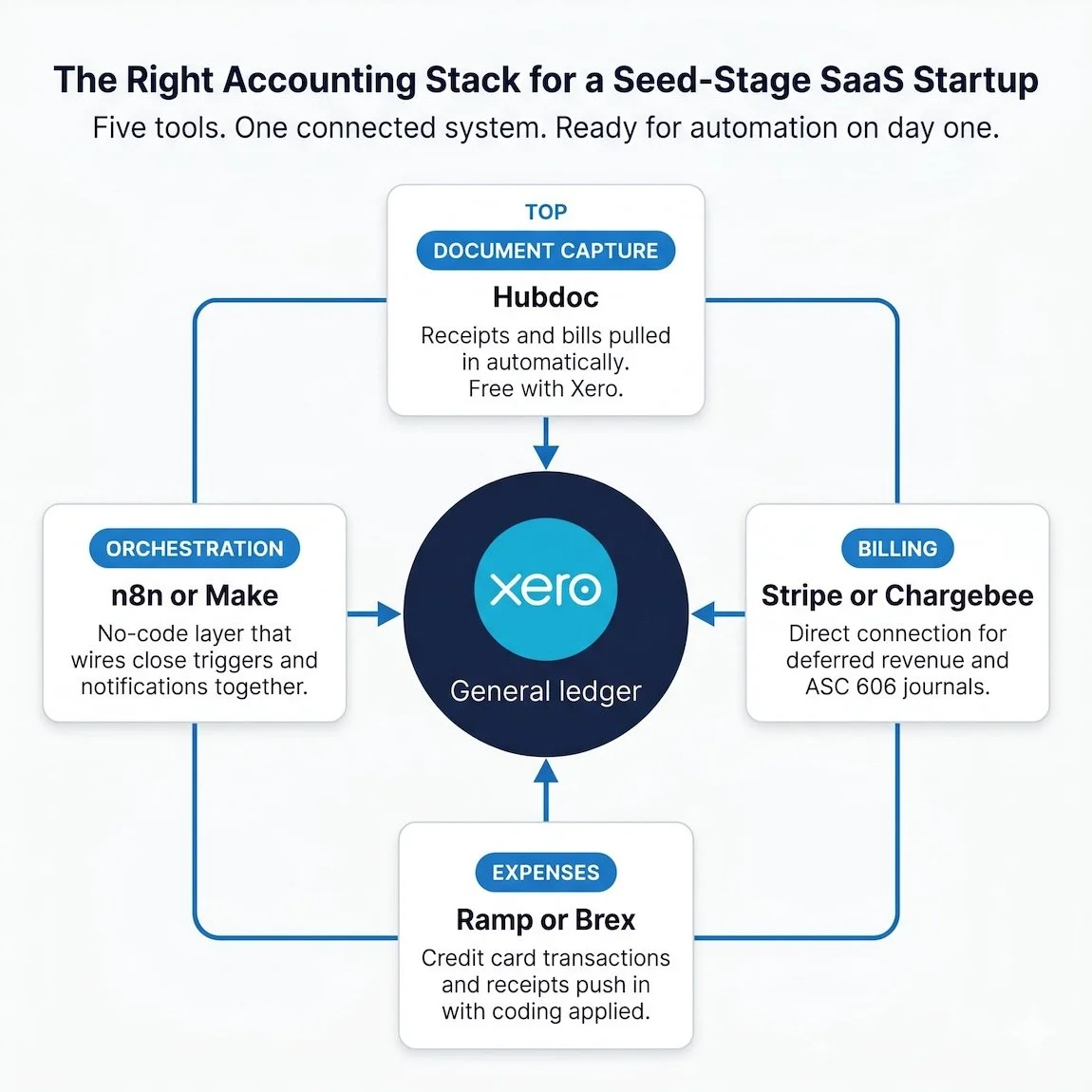
For most seed-stage SaaS startups, the core stack is Xero as your accounting platform, Hubdoc for document capture, Stripe or Chargebee for billing with a direct connection, Ramp or Brex for expenses, and a no-code tool like n8n or Make to wire it together. This stack supports automation, connects cleanly, and scales into Series B without a rebuild.
How do you automate accounting without making it more complicated?
Sequence the steps. Start with pre-staging recurring entries and bank reconciliation rules. Add document capture once those are stable. Tackle revenue recognition last, because it depends on the billing-to-accounting connection being clean. Automating all five at once creates complexity. Automating in order creates clarity.
Can AI agents actually handle month-end close tasks?
In 2026, AI agents handle certain tasks really well. Categorizing transactions. Pulling data from receipts and invoices. Flagging unusual activity. Drafting first-pass explanations for budget variances. AI agents do not handle judgment calls like accrual estimates, revenue policy decisions, or final review. The best setups use AI to amplify your team, not replace them.
How much time does full month-end close automation save per cycle?
For a typical seed-stage SaaS startup, whether pre-revenue or growing toward Series A, full automation saves 40 to 60 hours of team time per close cycle. That is roughly one full work week recovered every month. Across a year, that is 480 to 720 hours shifted from bookkeeping to analysis. For a lean team, that is enormous.
Closing
A fast, reliable month-end close is not a tooling problem. It is a setup problem, solved once, with the right sequencing. The five steps above cut most SaaS closes in half and free your finance team for the work that actually moves the business forward.
If any of this sounds familiar, we are happy to share what we have learned from building these systems at hundreds of SaaS startups. You do not have to figure it all out alone.
MATAX is a San Francisco-based startup operations and Xero advisory firm. MATAX is a two-time Xero Partner of the Year and Xero's 2025 Advisory Innovator of the Year.