

Fractional CFO vs Accounting Automation Firm
Most founders default to hiring a fractional CFO when the books feel out of control, and almost every one of them needs an accounting automation firm first.
The CFO solves a strategy problem, but your books are not a strategy problem. They are an infrastructure problem, and the difference decides whether the next $100,000 you spend on accounting builds a successful business or just buys you an expensive consulting invoice.
This is the conversation we have with founders every week. A pre-revenue startup raising a seed round, or a Series A SaaS startup at $2 million in annual recurring revenue, whose bookkeeper missed deferred revenue for three months running.
The founder assumes the answer is a fractional CFO at $8,000 a month, and sometimes that is the right call. Most of the time, it is an expensive way to patch the wrong layer.
Let me walk you through how to tell the difference between two very different functions.
What does a fractional CFO actually do for a startup?
A fractional CFO is a part-time strategic executive who sits above your books rather than inside them.
The work covers board reporting, scenario modeling, fundraising support, pricing strategy, unit economics, and budget versus actual variance review. They translate raw numbers into the decisions a business leader can act on with confidence.
Here is what they do not do. They do not reconcile your Stripe payouts, set up your chart of accounts inside Xero, build the integration between Ramp and your general ledger, fix the silent failures in your A2X accounting feed, or redesign your monthly close so it takes three business days instead of eighteen.
A good fractional CFO assumes your back office already works, which makes them the wrong partner for building that reliability in the first place.
What does an accounting automation firm actually do?
An accounting automation firm builds the operational infrastructure underneath your startup accounting function, and the work spans a wider technical territory than most founders expect.
The build covers Xero accounting services setup, ecommerce integration through A2X accounting, Ramp accounting automation, Stripe and payroll connections, document processing pipelines, monthly close redesign, and AI workflows that handle the repetitive transactional tasks your team is doing by hand right now.
The output is a back office that runs without constant manual intervention, where the books close on time and the numbers are clean enough to act on with confidence.
Team productivity climbs because the team stops chasing reconciliation tickets, and the founder finally stops being the chief reconciler inside their own company. The right automation partner builds the system, then your team operates it. We design it, we build it, your team owns it. That is the model.
Which one does your startup actually need right now?
Here is the diagnostic question that decides the answer fast. Are your numbers wrong, or are your numbers fine, but you do not know what to do with them?
If your numbers are wrong, late, or missing, you have a back office operations problem. A fractional CFO will sit on top of broken accounting data and produce confident-looking reports that do not mean anything.
You need the automation firm to fix the foundation. If your numbers are clean and arriving on time, but you cannot answer "what is our path to twelve months of runway at current burn," you have a strategy problem, and the fractional CFO is the right hire.
Almost every founder we talk to from pre-revenue through $5 million in annual recurring revenue has the first problem. They think they have the second.
When does a fractional CFO actually make sense?
There is a real moment for the fractional CFO, and it usually shows up at one of these familiar triggers.
You are raising a Series A or Series B and need a sophisticated narrative around metrics, cohorts, and unit economics.
You are launching a new pricing model and need someone who can model the impact across customer segments.
You are evaluating a strategic acquisition, a major hiring plan, or a capital raise structure.
You already have clean monthly statements and need someone to translate them into board-ready strategy.
Notice the pattern across every one of those scenarios. Each one assumes the books are already accurate and the back office already works. The fractional CFO is a multiplier sitting on top of a working system. They are not a substitute for building one.
When does an accounting automation firm clearly win?
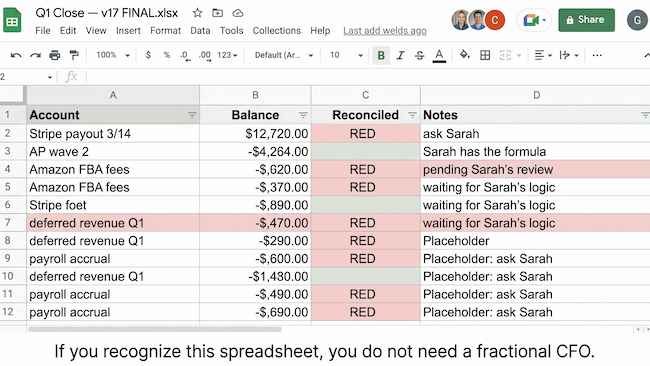
The triggers are very different, and you will recognize them right away. Your bookkeeper is "almost done with last month" on the fifteenth of the current month. The founder is still chasing missing receipts inside Ramp. The A2X feed broke, and nobody noticed for six weeks. Stripe payouts and Xero balances do not match, and nobody on the team can explain why.
You are running on QuickBooks Online or a generic setup that was never built for scaling startup operations. Your team is paying for nine disconnected platforms that do not talk to each other. These are infrastructure problems, and infrastructure problems get solved by the people who build infrastructure.
The integration ROI on a well-run engagement usually pays for itself within the first six months, not because you cut headcount, but because you stopped paying senior accounting people to do manual reconciliation work.
What does this actually look like when a founder gets the order wrong?
Here is a composite of a story we see all the time, especially in e-commerce.
A founder we worked with last year was running a hybrid direct-to-consumer and Amazon brand somewhere north of $2 million in gross merchandise value. Her CPA told her she needed a fractional CFO yesterday. So she hired one. $8,000 a month, sharp resume, former finance lead at a public retailer.
Three months in, she called us. The CFO had not produced a single board report. He was instead spending his $250 per hour billing every week trying to untangle why Shopify revenue, Stripe payouts, Amazon settlement reports, and the Xero general ledger never agreed with each other.
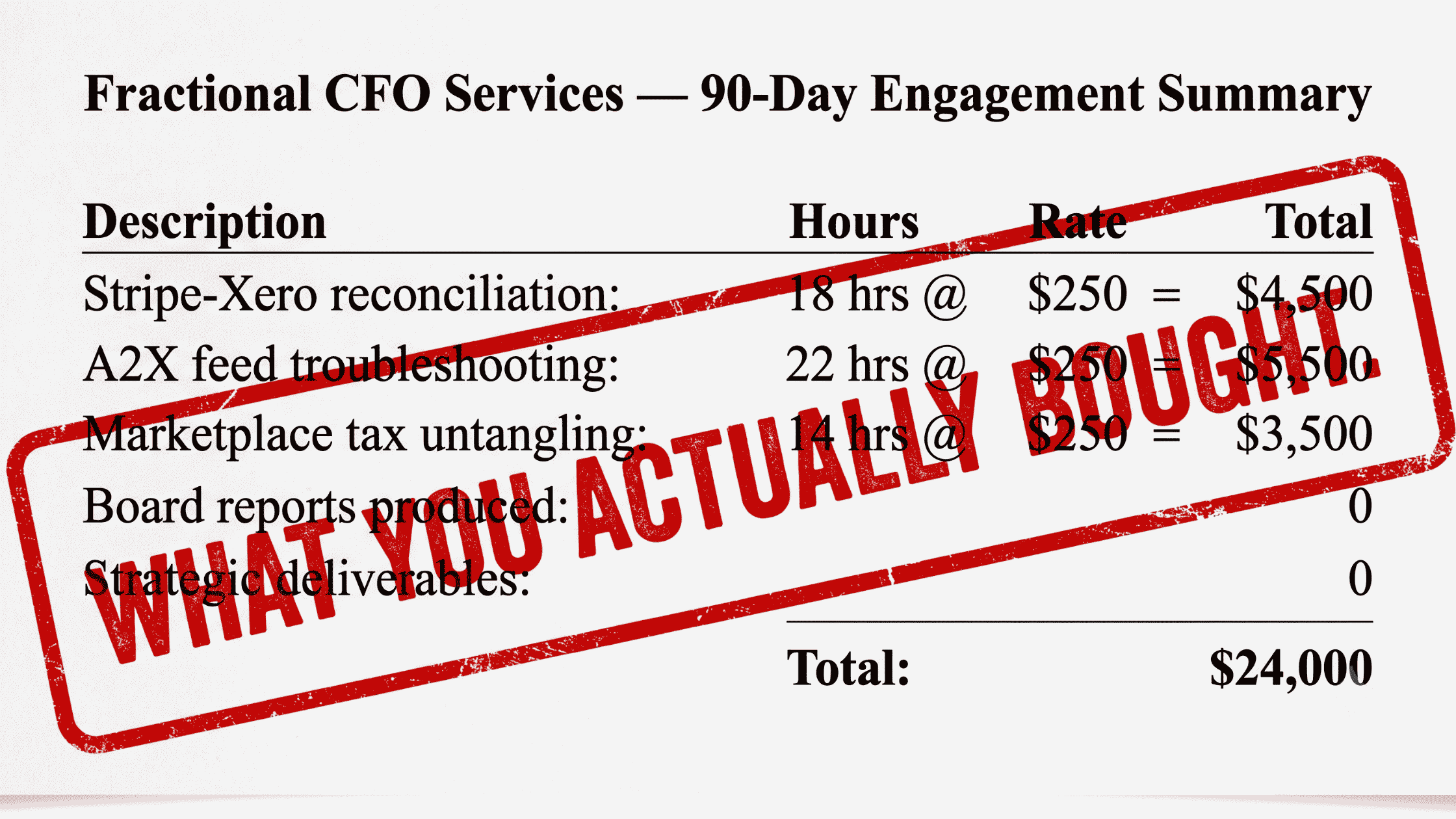
Her A2X accounting feed was misconfigured. Her marketplace facilitator tax handling was a guess. Three different people inside her company were copying numbers from screenshots into a Google Sheet that nobody trusted.
He was a good CFO doing the wrong job. He needed clean unit economics by SKU before he could model customer acquisition cost or contribution margin. The clean unit economics did not exist yet. So instead of strategy, he was performing forensic bookkeeping at executive rates, and the founder was paying twice for the same broken foundation.
We came in, rebuilt the integration between Shopify, Stripe, Amazon, A2X, and Xero, redesigned the close so it took three business days instead of nineteen, and stood up a clean monthly process her in-house controller could own.
The total engagement landed under what the CFO had already burned through trying to fix the books himself. Two months later her CFO was finally doing CFO work, because there was a working system to do it against.
The lesson is the principle. Build the operational infrastructure first. Layer strategy on top.
Can you actually have both, and in what order?
Yes, and yes, but the sequence matters, and the sequence is where most founders make the expensive mistake.
Founders typically hire the fractional CFO first because that is the role they have heard of. The CFO arrives, asks for clean monthly statements, finds the back office is broken, and either tries to fix it personally at executive billing rates or recommends you hire someone separately to fix it. Either path means you paid for strategy work and got infrastructure work.
The sequence that builds a successful business is the opposite.
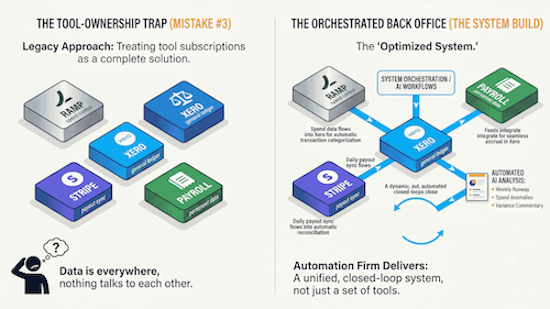
The accounting automation firm sets up the system integration, designs the workflow improvement, ramps your team on the flexible systems, and hands you a back office that runs.
Then the fractional CFO arrives and does real CFO work, because there is finally a working system to do that work against. The total spend over twelve months is similar. The outcome is very different.
What changes when AI agents enter the back office?
The line between these two roles is getting blurry fast, and the blur favors the automation firm.
A modern accounting automation firm is no longer just connecting Xero to Stripe with a basic integration. We are designing AI workflows that read invoices, categorize transactions, flag anomalies, draft the first version of the monthly close, and surface the questions a human reviewer needs to answer.
AI-powered integrations are now doing tasks that used to need a senior accountant or a junior controller.
What used to be CFO-only work, including real-time runway tracking, scenario modeling, and variance commentary, is now built into the back office itself when the infrastructure is designed for it. We see clients running automated weekly runway reports, AI-flagged spend anomalies, and continuous close workflows that surface the same insights a fractional CFO would deliver inside a monthly review meeting.
This is the part most founders miss. The automation firm is no longer just fixing the boring parts of the back office. They are building the layer that delivers a big slice of what a fractional CFO used to deliver. You still need a strategic brain at the right moments, but you need less of it than you think.
What are the most common mistakes founders make here?
Pattern recognition from hundreds of startup conversations turns up four recurring mistakes that show up across very different business models and funding stages. The first mistake is hiring the fractional CFO before the underlying books are accurate, where the CFO produces a beautiful strategic deck on top of broken data, the board asks one specific drill-down question, and the whole story falls apart inside the meeting.
The second mistake is hiring a bookkeeper to fix what is really a systems and integration problem. Bookkeepers categorize transactions. They do not architect your AI automation stack, build your no-code integration solutions between disconnected tools, or stand up document processing pipelines for your accounts payable workflow. Asking them to do that engineering work is asking the wrong person.
The third mistake is treating every new tool subscription as the full solution. Ramp does not fix your close on its own, Xero does not optimize itself, and Stripe does not magically reconcile to your general ledger without setup.
The tools matter, but the orchestration between the tools matters more, and workflow optimization is the real deliverable you are buying. The fourth mistake is waiting too long to address infrastructure at all.
Founders tell us "we will get to it after the round closes," and then the round closes, the headcount doubles, the data quality drops, and now you are rebuilding plumbing while running at three times the previous speed. The cheap moment to design the infrastructure is before you are scaling on top of it.
How do you decide between a fractional CFO and an accounting automation firm?
Use this short diagnostic, and answer honestly.
Are your monthly books reliably closed within three business days of month-end? If no, you need the automation firm.
Do you trust the numbers inside your dashboard enough to make hiring decisions from them? If no, you need the automation firm.
Can someone besides the founder explain how Stripe revenue flows into Xero and out to your investor reports? If no, you need the automation firm.
Are your last three months of statements reconciled, categorized, and free of "ask Sarah" placeholder entries? If no, you need the automation firm.
Do you have a real integrated stack across Xero, Stripe, Ramp, and payroll, or are people copying numbers manually between disconnected platforms? If you are copying anything, you need the automation firm.
If you answered yes to all five questions, congratulations, because you have a working back office. You are finally in the actual market for a fractional CFO, and they will be worth every dollar. Different business models hit this threshold at different stages: SaaS startup, ecommerce, professional services. Almost all of them reach the automation firm threshold first, and the fractional CFO question lands later, usually after the Series A is closed.
What should you do this week?
If you recognize your own situation inside any of this, the move is not to hire either function tomorrow. The move is a short diagnostic of your back office.
Open your last three monthly closes and time how long each one took from "month-end" to "books locked." Look at what specifically went wrong inside each one, and look at how many of those problems were the same problem repeating across multiple months.
That repeating pattern is your infrastructure gap, and that gap is what an accounting automation firm is built to fix.
If the pattern is "everything took too long because the system was never designed for this stage of the business," you have your answer.
You need the partner who builds the system before you need the executive who reads the reports. We have walked hundreds of startups through this exact decision, holding Xero Advisory Innovator of the Year recognition, and focused on the seed through Series B window, where this question lands hardest.
If you want to talk through your specific setup and figure out which side of the line you are on, we are happy to have that conversation.
Dawn Hatch is the Founding Partner of MATAX, a San Francisco-based firm that designs and builds the accounting systems, AI workflows, and back office infrastructure that let startups scale without proportional headcount growth. MATAX is a two-time Xero Partner of the Year and Xero's 2025 Advisory Innovator of the Year.
