

When AI Back-Office Automation Pays Off for Startups
The right time to bring AI automation into your back office operations has nothing to do with your company's size or your funding stage. It comes down to two numbers: how often the task repeats, and how stable the process is. Get the timing right and one well-built agent hands back 15 to 25 hours a close cycle, real operational efficiency you can point to. Get it wrong, and you either rebuild the workflow every few weeks or leave real hours on the table for months.
We see both mistakes constantly across the startup operations we support, from pre-revenue through seed stage. Most either try to automate everything on day one or wait until the month-end close eats two full weeks before they even ask the question. Neither is the right instinct.
As of Q2 2026, the tooling is stable enough to trust with real financial data, so the real question is not whether AI agents can help. It's whether your task, at your current volume, has crossed the point where building pays back faster than doing it by hand.
Why is this suddenly a real question for founders?
This question used to be theoretical. In 2025, and now into Q3 2026, it stopped being theoretical because n8n workflow automation and AI agents, along with similar automation tools, can now run multi-step back-office work without constant babysitting. Error rates have dropped enough that putting a real financial process through an agent is no longer a leap of faith.
At the same time, pressure on startup back offices has gone up. Investors want faster reporting, boards want real-time dashboards, and founders are running leaner teams, chasing increased productivity from fewer people. A 20-person SaaS startup is now expected to close its books almost as fast as a 200-person company could have a few years ago, and that gap is exactly what pushes founders to ask about automation before they're sure it's worth it.
That is the trap. Asking "Can AI do this?" is the wrong first question. "Has this task crossed my break-even point yet?" is the one that actually saves you the rebuild.
How do you calculate the ROI on an AI back-office agent?
A quick filter: task frequency multiplied by time per instance. A task that happens 20 or more times a month and takes 5 or more minutes each time adds up to over 100 minutes a month of automatable time. A well-built agent workflow takes 10 to 15 hours to build and test, so it pays for itself in under three months at that rate.
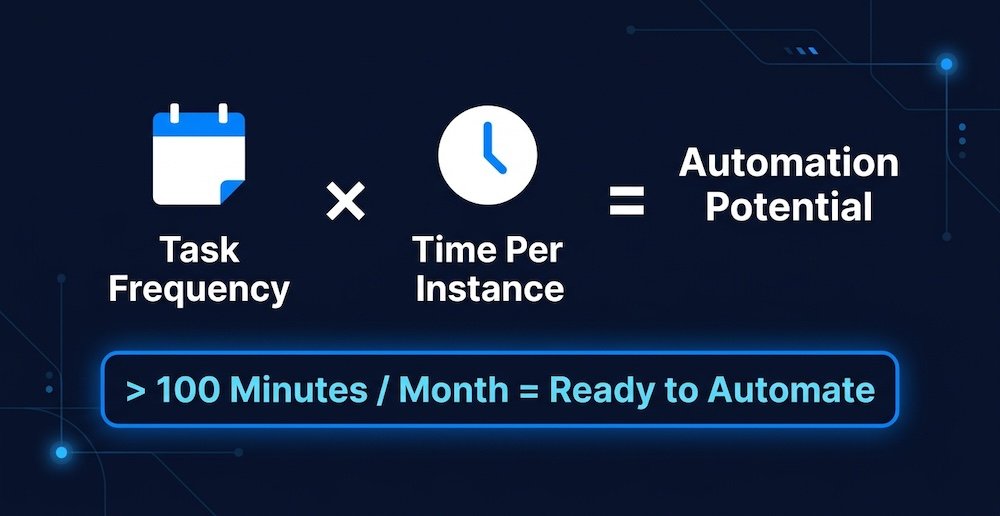
That math only holds if the process is stable. An agent built around rules that change every quarter doesn't pay back; it just costs you the same 10 to 15 hours again every time the workflow breaks. Before you run the math, ask whether the steps have stayed the same for the last two close cycles. If not, the ROI calculation is premature, no matter how many minutes the task burns today.
What transaction volume tells you it's time to build?
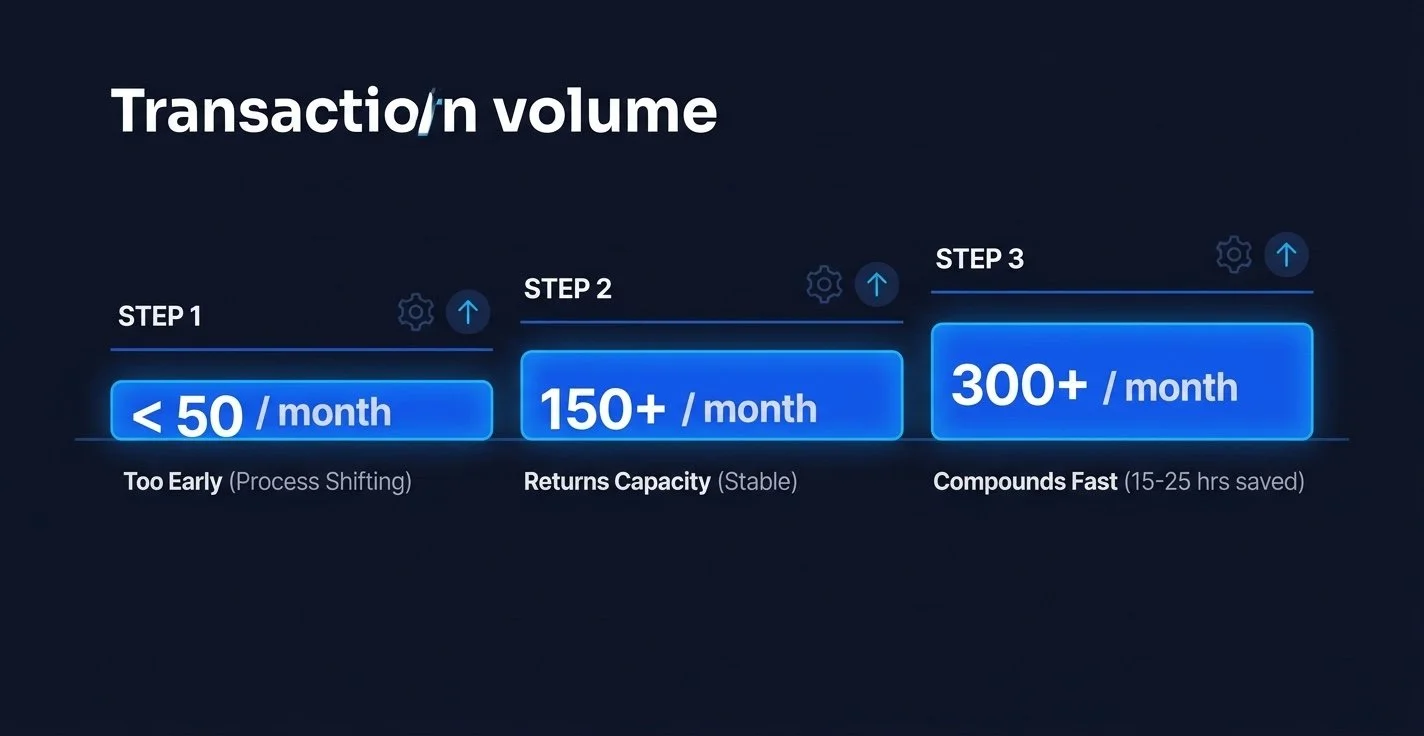
Transaction volume is the clearest signal you have, clearer than revenue, headcount, or funding stage. Every startup runs a different business model, and if yours is still shifting every quarter and you're under 50 transactions a month, automating too early creates more work than it saves. The process changes, and you end up rebuilding the agent six weeks later.
At 150 or more transactions a month on a stable model, with the same steps repeating every close cycle, agents start returning real capacity. At 300 monthly transactions, a well-built agent workflow typically gives back 15 to 25 hours per close cycle, and that savings compounds month over month once the system runs without you.
We've built back-office agent workflows for pre-revenue startups spending 15 hours a month on bookkeeping. After the agent went live, that dropped to under two hours of review time a month. The volume was modest, but the process was stable, and stability is what made the math work.
Which accounting tasks pay back fastest once you cross that threshold?
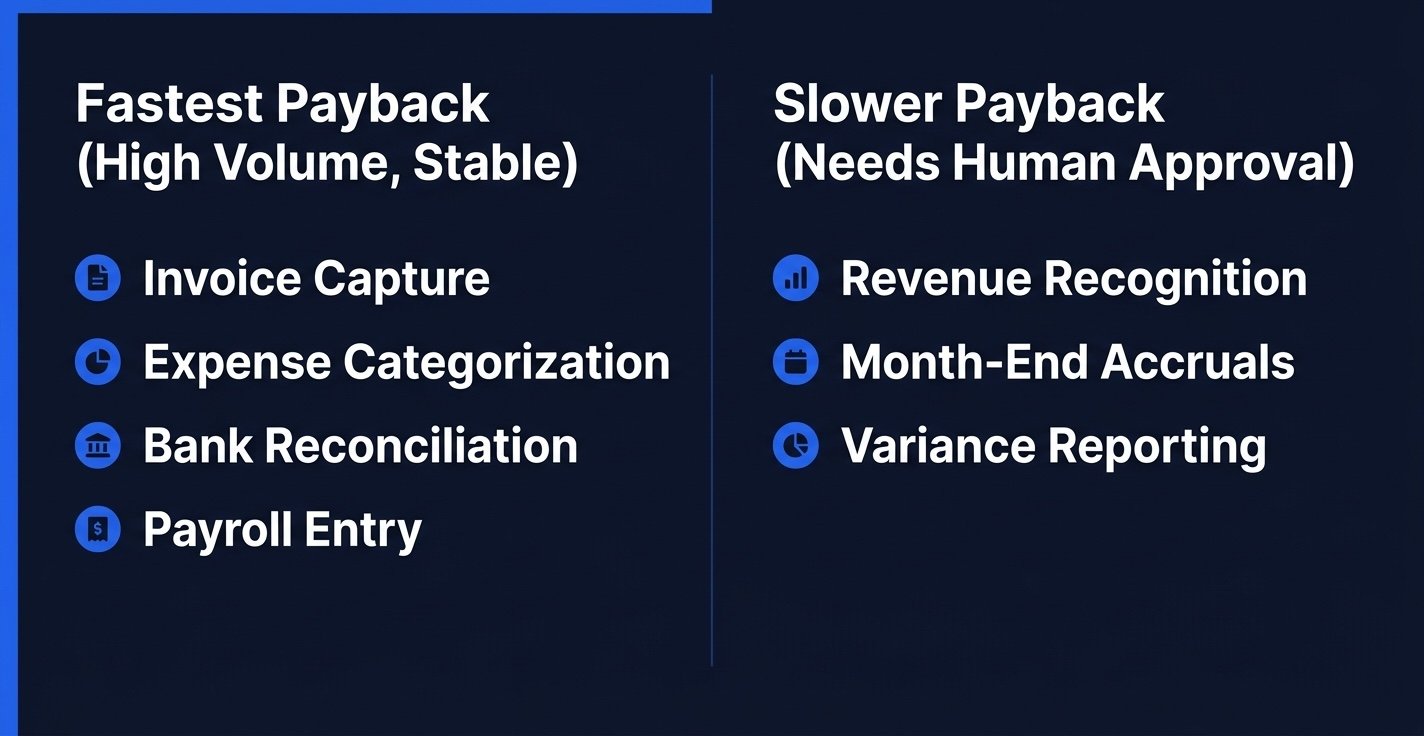
Here's where that math tends to land first, based on what we've built and tested in production, organized by how reliably each task runs without human help after setup.
Invoice capture and three-way matching, essentially document processing at the AP layer, pays back quickly once volume is steady. Agents read PDF invoices, pull the vendor name, amount, and due date, match them against purchase orders, and push approved invoices into Xero with the right GL code. That kind of system integration used to take a developer to wire up. Error rates on well-structured invoices run below 5% once the agent is trained on your vendor set.
Expense categorization and bank feed reconciliation follow the same pattern. Card transactions from tools like Ramp or Brex get categorized in real time, and Ramp accounting automation in particular has gotten reliable enough that a well-tuned agent hits 90 to 95% accuracy on routine transactions without manual review. Bank reconciliation is almost fully automatable once transaction types stay consistent. A 20-person startup might review 15 to 20 flagged items a week instead of reconciling 300 transactions by hand.
Payroll data entry pays back on cadence rather than volume. Moving approved hours or salary data from your HR system into payroll, then back into Xero, is repetitive work agents handle reliably because the verification steps stay the same every cycle.
Further down the payback curve are tasks where an agent drafts and a human approves each cycle, which take longer to earn back their setup time because a person still touches every output. Revenue recognition, month-end accruals, variance reporting, and vendor payment runs all fall here. An agent can calculate flat SaaS revenue entries, but anything touching ASC 606 in a non-obvious way needs a human sign-off. It can format the actuals-versus-budget report, but the narrative explaining why spend moved needs someone who understands what actually happened.
What do founders get wrong about the timing?
The most common mistake is building for judgment before building for volume. A founder still hand-coding expenses and reconciling bank transactions one by one will sometimes ask whether AI can model cash flow scenarios or draft investor updates instead, long before the routine layer justifies a build. Run the frequency math first, automate the high-volume, stable-rule tasks cleanly, and only then move up toward anything needing real context.
The second mistake is underestimating the setup work and skipping exception handling once you decide to build. A working invoice agent didn't get there in an afternoon. It took a training period, example transactions, clear rules for edge cases, and a parallel human review loop for the first 90 days to catch errors before they mattered. That upfront cost is exactly why the ROI math above matters: spend those 10 to 15 hours on a task that has actually crossed its break-even point, not one that merely feels annoying this week.
Every agent also needs a clear fallback path for anything it can't resolve with confidence. Leave an unclear transaction uncoded, and you get gaps in your close. Flag it for human review and route it to the right person, and you have a working system. The exception logic matters as much as the core logic, and it's part of the setup cost you're pricing in before you build.
Here's the pattern I see over and over in my work with startups. The back-office work that will consume your team's capacity over the next 12 months isn't the complex judgment work. It's the 200 routine transactions they're touching manually every month when an agent could handle 180 of them and flag 20 for review.
How do you know which task to build first?
Once a task clears the volume and stability threshold, sort what's left by two questions: can it be defined as a series of verifiable steps with a correct output, and does it repeat on a predictable cadence? Answer yes to both, and you've found your next workflow optimization project.
High repetition with clear rules is where agents perform best and where the ROI math pays back fastest. High repetition with murky or changing rules is where they make expensive mistakes, often quietly, no matter how attractive the frequency math looks on paper. Low repetition with clear rules is usually faster to do by hand, and low repetition with unclear rules is always human work, regardless of volume.
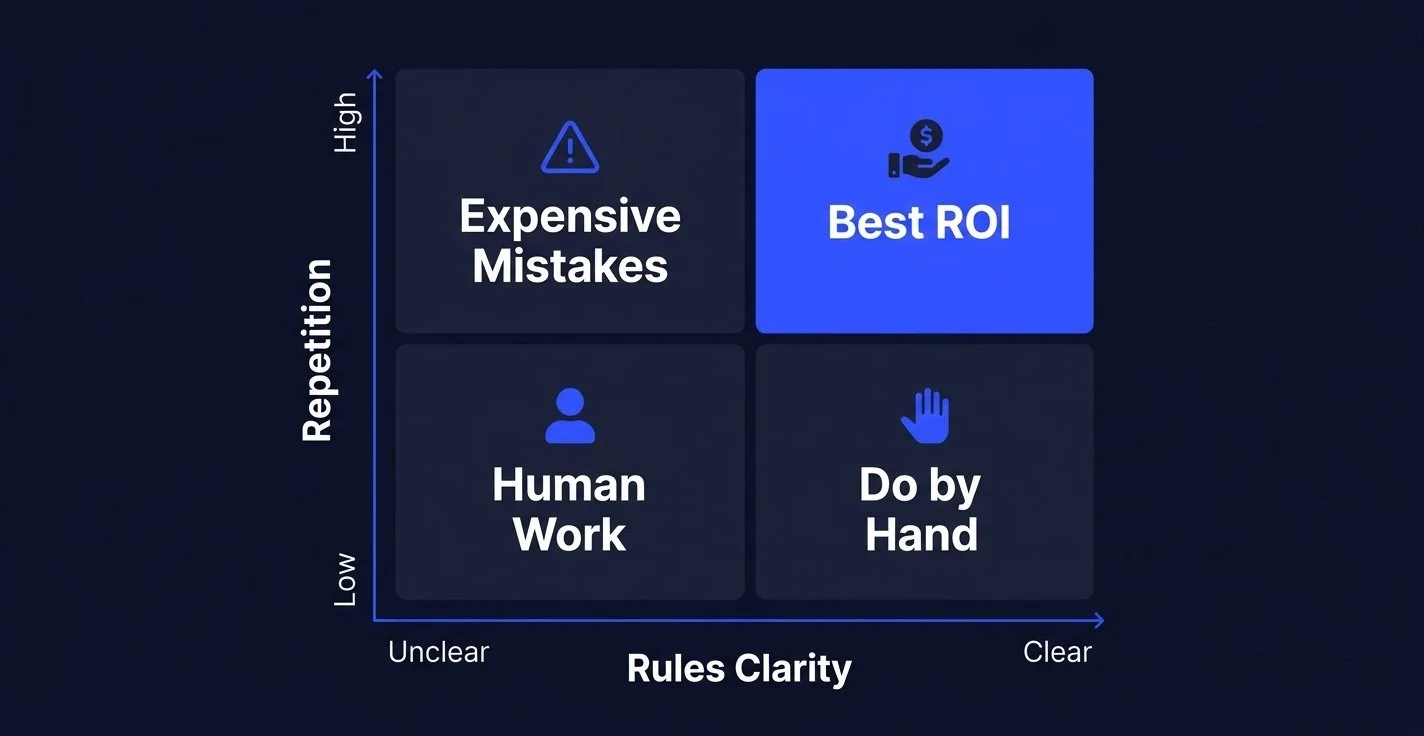
This sorting logic is the foundation of MATAX™ CoreOps, the three-layer framework we use to design a startup's back office: the Core, your accounting built as the hub; the Orchestration, the automation and AI running the repetitive work; and the Governance, the human control on every judgment call. The Orchestration layer is where back-office agents live once they clear the threshold, and Governance sets which decisions still need a human sign-off regardless of volume.
The MATAX team has built these agent workflows across startup stages and industries, backed by two-time Xero Partner of the Year recognition and the 2025 Advisory Innovator of the Year award. The pattern holds: getting the timing right decides whether a back-office automation project returns lasting capacity or turns into a maintenance burden.
What should you do this week to test the ROI on one task?
Start with a 30-minute audit instead of a build. Go through everything that touched your back office in your last close cycle, and for each task, run the frequency math: how many times a month, how many minutes each time.
Pick the task with the highest score that also has stable, unchanging rules, which, for most pre-seed through Series A startups, is either expense categorization or bank reconciliation. If the top-scoring task's rules are still shifting, move to the next one down the list, because volume alone doesn't clear the bar.
Before you build anything, write out the exact steps a human would follow to finish that task. If you can't write the steps clearly, the agent can't follow them either, and no amount of transaction volume fixes a vague process.
Build a minimal version that handles the most common cases and run it alongside your manual process for 30 days. That parallel run confirms the ROI math held and shows where the agent needs more training. If you use Xero, both n8n and Make connect directly through the Xero API, the backbone of most of the AI workflows and back-office agent workflows we build.
FAQ
How do I calculate the ROI of an AI back-office agent before I build it? Multiply how often the task happens each month by minutes per instance. Over 100 minutes a month against a 10-to-15-hour build typically pays for itself within three months, freeing up real team productivity you can redeploy elsewhere.
What transaction volume justifies building an automation instead of doing it by hand? Under 50 transactions a month on a shifting business model usually isn't worth automating yet. At 150 or more on a stable process, agents start returning real capacity, and at 300, the payback compounds fast.
What's the biggest timing mistake founders make with back-office automation? Building for judgment before building for volume. Founders reach for AI automation on the hardest, most ambiguous decisions before the routine, high-volume, stable-rule tasks are handled, wasting the setup investment on the task least likely to pay it back.
How long does it actually take to build a back-office AI agent that works? Plan on 10 to 15 hours of setup: training period, example transactions, edge-case rules, and a parallel human review loop for the first 90 days. That cost is one-time; the capability runs every close cycle after.
Is there a point where a task is automated too early? Yes. If the process is still shifting every quarter, an agent built around today's rules gets rebuilt every time the workflow changes. Wait for two stable close cycles before running the ROI math.
Closing
Most startups don't automate the wrong task; they automate the right task at the wrong time, before volume or stability has actually earned it. Run the frequency math on your last close cycle this week, then hold whatever tops the list against the transaction threshold above before you build anything. One well-built agent, built at the right moment, returns more capacity than a full business automation strategy launched too early or too late. If you want a second set of eyes on that math for your stack and stage, reach out. The first conversation usually makes the starting point obvious.
About MATAX
MATAX is the accounting partner that growing startups run on. We handle the startup accounting and bookkeeping that keeps your numbers clean and your close on time, and we design, build, and optimize the automation and AI systems layered on top of it, connecting all three into one integrated whole. We design it, we build it, your team owns it. Founded in 2006 and based in San Francisco with a U.S.-based team, MATAX has worked with hundreds of startups across dozens of industries, and is a two-time Xero Partner of the Year for our Xero accounting services and the 2025 Advisory Innovator of the Year. We've built with governed, ethical AI since 2023, and the framework behind that work is MATAX™ CoreOps, a three-layer model that keeps a human in control of every judgment call. Scaling startup operations without losing control of your books is what accounting for startups should look like. If your books or operations have outgrown the tools holding them together, start a conversation at mataxhq.com.
About the author
Dawn Hatch is the Founding Partner of MATAX. She's spent 20 years building the accounting and operational backbone that startups depend on to grow into a successful business, working directly with founders to design systems they can actually trust as they grow. She writes about the real operational work of running a startup, from the month-end close to the AI agents quietly reshaping how finance teams work.
