

DIY Bookkeeping vs AI Bookkeeping vs a Pro Firm
When to Switch in 2026
The short answer
The right time to switch from DIY bookkeeping to a professional firm is the moment the combined cost of staying DIY (your time, your accumulated errors, your fundraise exposure) exceeds the cost of hiring well. For most SaaS startups and scaling SMBs, that threshold arrives somewhere between early traction and the first significant capital raise, which is almost always sooner than founders expect.
Here's the part most articles continue to skip in 2026: DIY no longer means "just you in QuickBooks." It also means "you plus an AI bookkeeping subscription." Both options have real limits, both will reassure you they're working long after they actually aren't, and the warning signs are completely different between the two.
This is the question we hear from founders every week: should I keep doing the bookkeeping myself, subscribe to one of the new AI bookkeeping apps, or move to a professional firm with AI built into its delivery? The framework below is exactly how we walk founders through the decision.
Why this decision looks different in 2026
A few years ago, the choice was binary: you did your own books in QuickBooks or Xero, or you hired a bookkeeper. In 2026, there are three real options on the table, and the middle one is genuinely new:
1. DIY (manual). You categorize transactions, run the close, and reconcile everything yourself. Cheap to start, painful the moment something breaks.
2. AI bookkeeping app alone. A subscription tool (Puzzle, Zeni, Inkle, Pilot's AI tier, Kick, and the rest) that handles the routine work and presents you with a clean dashboard. Mid-priced, and it promises a lot.
3. Pro firm with AI built in. A real human (or team) running your books while AI handles the volume work underneath. Higher monthly cost, and the only model that consistently catches the 10% to 20% AI gets wrong.
The mistake we see most often is founders treating options 2 and 3 as the same thing, when they really aren't. An AI bookkeeping app gives you speed and a clean interface. A pro firm gives you judgment, context, and someone who picks up the phone when an investor asks you a hard question on a Friday afternoon.
Both have a real place. The question is which one fits where you are right now.
Six signals you've outgrown DIY bookkeeping
These are the signs we see most often when a founder is overdue to move on from doing the books themselves.
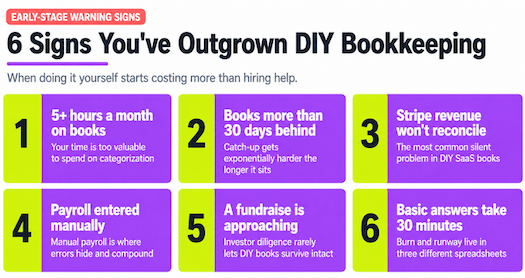
1. You're spending more than 3 to 5 hours a month on bookkeeping yourself.
When accounting is consuming your founder hours, it's consuming your single most valuable strategic resource. Industry data places typical small business owners at roughly 8 to 10 hours per week on bookkeeping responsibilities, which translates to a full additional workday every week that should be going toward product, customer relationships, or recovery.
2. The books are more than 30 days behind on closing.
Persistently behind books mean you're systematically making important decisions on noticeably stale data, and the catch-up effort grows exponentially harder the longer the backlog accumulates. Reconstructing two months of activity in June is dramatically harder than catching up two weeks in January.
3. Your Stripe revenue does not reconcile cleanly to your accounting records.
This is consistently the most common silent problem in DIY SaaS bookkeeping, because the default Stripe integration routinely misclassifies revenue, processing fees, and customer refunds. If you're genuinely uncertain whether your revenue figures are accurate, they very likely aren't.
4. Payroll is being entered manually every single month.
When payroll isn't fully automated, the remainder of your back office infrastructure almost certainly isn't either, and manual payroll handling is precisely where small individual errors compound into expensive cumulative problems.
5. A meaningful fundraise is approaching on your timeline.
Investor due diligence examines your books with a level of detailed scrutiny that DIY accounts rarely survive intact. The appropriate moment to address this exposure is 6 to 12 months before the round opens, not during the diligence process itself.
6. You can't answer a basic question about the business without 30 minutes of digging.
"What's our real burn rate this month?" "What's our gross margin per customer cohort?" "How much runway do we genuinely have remaining?" When those answers live scattered across three different spreadsheets and require coffee to retrieve, the underlying infrastructure has already broken.
If two or more of those signals hit, you're past the line.
Six signals you've outgrown AI bookkeeping apps too
This is the new section nobody seems to be writing yet. Most articles stop at the DIY-to-pro line. They miss the second wave: founders who graduated from DIY to an AI app, felt great for six months, and then started noticing things were not quite right.
If you're using a standalone AI bookkeeping subscription right now, here's when it's time to add a human (or move to a firm that bundles both).
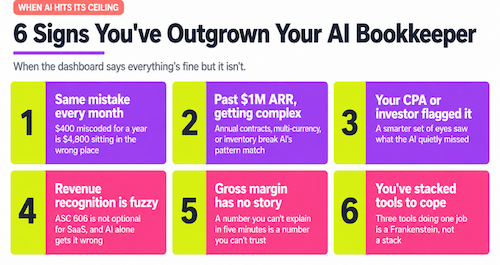
1. The AI is making the same category mistake every single month.
AI categorizes transactions at roughly 85% to 95% accuracy, which sounds reassuring until you realize it has been confidently wrong about the same $400 monthly subscription for twelve consecutive months, leaving $4,800 parked in the wrong category. AI doesn't self-correct on these recurring patterns unless someone explicitly identifies and fixes the underlying rule.
2. You're approaching $1M in revenue with anything more complex than basic monthly subscriptions.
Annual contracts, usage-based pricing, multi-currency operations, international payroll, or physical inventory will each individually break the pattern-matching that powers AI bookkeeping. The answer isn't reducing automation but rather adding judgment, meaning automation paired with someone who actually understands how to handle the resulting exceptions.
3. Your investor or CPA has flagged something specific on the books.
When a sophisticated outside reviewer has expressed concern about something they've seen, the AI app demonstrably missed it during ongoing operation. That gap isn't a temporary bug in the tool you can patch around; it represents the practical limit of what the model can detect on its own.
4. Revenue recognition is your real question and you don't have a clear answer.
ASC 606 compliance isn't optional for any SaaS company that intends to raise capital, and AI tools alone don't handle ASC 606 reliably without explicit human configuration. If your annual contracts are landing as one large revenue spike in the month they're signed instead of being recognized monthly across the service period, your dashboard is lying to you in a way investors will detect during week one of diligence.
5. You can't explain your gross margin to a smart outsider in under five minutes.
When the AI has provided you with a margin number but you genuinely can't trace where the number came from or confirm whether it's accurate, you're already past the threshold of what the tool alone can deliver. Investors and acquirers will ask exactly that question, and "the AI calculated it" is rarely an acceptable answer.
6. You're quietly stacking tools to compensate for what your primary app isn't doing.
When your AI bookkeeper plus a separate spreadsheet for revenue plus another tool for payroll reconciliation has gradually become your operational stack, you've effectively built a Frankenstein system without realizing it. A capable professional firm replaces all of that with a single human plus the same underlying automation, running together as a coherent system rather than as a collection of disconnected pieces.
If two or more of those signals hit, AI alone has hit its ceiling. Time to layer the human back in.
What a "pro firm" actually means in 2026
The word "pro" used to mean someone working inside QuickBooks doing exactly what you used to do, just faster. Today, a real pro firm looks substantially different:
AI handles the 80% routine work (categorization, reconciliation, document processing, transaction matching).
A human handles the 20% that needs judgment (revenue recognition calls, accruals, board-ready commentary, exception review).
Integrations are configured properly the first time, with Stripe, Ramp, Mercury, Gusto, and Shopify all flowing into Xero or QuickBooks correctly from day one.
The monthly close lands in 5 business days, not 25.
You get a real person on the phone when your investor asks something unexpected.
If a firm is selling you "pure human" with no automation, they're going to be slow and expensive. If a firm is selling you "pure AI" with no human, you're effectively back to option 2 with a different marketing label. The only model that holds up at scale in 2026 is the hybrid, with both layers running together inside the same engagement.
What does it actually cost?
These are the numbers founders ask us about almost every week. April 2026 averages, US market:
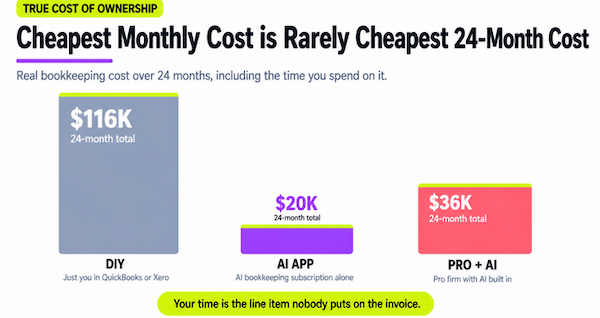
DIY (just you in QuickBooks/Xero). $30 to $80/month in software, plus 8 to 10 hours of your time per week, which at a $150/hour opportunity cost translates to $4,800 to $6,000/month you're not invoicing yourself for.
AI bookkeeping subscription alone. $50 to $400/month depending on transaction volume.
Pro firm with AI built in. $800 to $2,500/month for early-stage SaaS, depending on volume, complexity, and whether you need controller-level oversight in the engagement.
The cost gap between AI alone and a pro firm narrows fast once you factor in cleanup work. We've watched founders spend $15K on cleanup right before a Series A because their AI-only setup had been quietly miscoding for 18 months, and the original "savings" went up in smoke during a single emergency engagement.
The real math isn't monthly cost. It's total cost of ownership across two years, including cleanup, missed credits, and time spent on work that should never have been yours.
The right time to switch is almost always earlier
The single most common mistake we see is waiting too long, which produces a recognizable pattern. The founder runs DIY through early traction, gets busy, and hands the books to a generalist who is willing but unequipped. Months later, the founder switches to an AI subscription out of frustration, and feels relieved for about six months. Then a fundraise approaches, the books need real work, and the entire cleanup happens during diligence at the worst possible moment.
Every step in that pattern costs measurably more than the step before would have. The founder who moved to a pro firm at $500K ARR consistently pays less across two years than the founder who waited until $3M ARR and absorbed an emergency cleanup engagement right before a raise.
The principle is simple: switch before complexity outgrows your current setup, not after the books have already started failing. For most SaaS startups, that decision point lands somewhere between $500K and $1M ARR. For scaling SMBs, it tends to be the moment you cross any of these thresholds: 200 monthly transactions, 10 employees, inventory, or multi-channel revenue.
Frequently asked questions
Can AI replace my bookkeeper entirely?
No. AI handles the routine portion of bookkeeping quickly, but it cannot reliably handle the judgment calls, the exceptions, or the conversations that develop when something looks off. The most effective 2026 configuration pairs AI with a human reviewer, not one capability working in isolation.
Should I just stay in QuickBooks and do everything myself?
If you're under $250K raised, your transaction volume is low, and your business model has few moving pieces, the answer is probably yes for now. The economics still favor DIY at the earliest stage, but they shift quickly the moment you cross any of the six DIY signals above.
Will an AI bookkeeping app catch up to a pro firm eventually?
Not in the way most marketing implies. The bottleneck isn't AI capability; it's the portion of the work that requires context and judgment, which is exactly the portion that doesn't pattern-match. A skilled bookkeeper paired with good AI will keep outperforming any AI-alone configuration for the foreseeable future.
What if my books are already significantly behind?
It's not too late, although the further behind your records are, the more cleanup is involved. A capable firm will assess the backlog during discovery, build a cleanup plan, and get you current alongside constructing your new infrastructure. The full process is achievable in 6 to 10 weeks for most companies.
How do I tell if an AI bookkeeping app is genuinely enough?
Three honest questions. Are your books exclusively simple monthly subscriptions?
Are you under $1M ARR?
Do you have someone capable reviewing the AI's work weekly?
If all three answers are yes, the app is probably sufficient. If any single answer is no, you need the hybrid configuration.
What should I do before I engage a firm?
Almost nothing, intentionally. Let the firm assess your current state during discovery instead of pre-cleaning. What helps is giving them prompt access to your bank accounts, accounting platform, payroll data, and any notes on accounting decisions you've made. Pre-cleanup often obscures exactly what they need to evaluate.
How long does the switch typically take?
For a company with reasonably clean books, the timeline is 4 to 8 weeks. For a company with a meaningful backlog, expect 8 to 16 weeks. The first month is parallel work, where your existing setup keeps running while the firm builds the new infrastructure alongside it. Cutover happens once both configurations reconcile to identical numbers.
Will I lose visibility during the switch?
You shouldn't, and you should be skeptical of anyone who suggests otherwise. A capable firm runs both setups in parallel until they produce identical numbers consistently, then cuts over only after that match is confirmed. If anyone asks you to "go dark" for a month during migration, walk away.
The honest summary
DIY bookkeeping made straightforward sense in 2018, and AI subscription tools complicated the picture in 2024. In 2026, the relevant question is no longer "DIY or pro." The actual question is "where on the spectrum do I sit, and what is staying there costing me?"
If you can't answer that confidently in five minutes, talk to someone who can help map it out.
We've walked hundreds of founders through this decision. Some stay DIY because the math supports it. Some land on AI alone because their business absorbs the trade-offs. Most who come to us end up in the hybrid because that's where their complexity actually lives.
There's no universally wrong answer. Only the wrong answer for where you are.
Dawn Hatch is the Founding Partner of MATAX, a San Francisco-based firm that builds the accounting systems, AI workflows, and back office infrastructure that let startups scale without proportional headcount growth. MATAX is a two-time Xero Partner of the Year and Xero's 2025 Advisory Innovator of the Year.
