
How Does AI Bookkeeping Work for a Series A Startup?
Two of our clients closed their Series A rounds last month. I've been working with both of them since early stage: messy books, manual reconciliation, a Stripe connection that barely worked. Last month, both of them closed their rounds.
That matters to me right now because funding has slowed significantly across the board. Most founders I talk to are hearing "not yet" more than they ever expected. So when clients of ours are closing in this environment, I pay attention to what was different. And what I keep coming back to is the infrastructure.
Clean books delivered fast. Revenue recognition done correctly. A close process that didn't require two weeks of cleanup before anyone could look at the numbers.
That's not the only reason they raised. But it's the reason their due diligence didn't become a crisis. And it's why I wanted to write this.
It's not about replacing your accountant.
That's the first thing I want to clear up, because "AI bookkeeping" sounds like a threat to the people doing your accounting. It isn't. What AI-powered bookkeeping actually does is take the manual, repetitive work off their plate so they can spend their time on the things that require judgment: revenue recognition calls, cash flow decisions, board reporting, fundraising prep.
At seed stage, you could survive without this. Transaction volume was low. Being a month behind on the books was annoying but not dangerous.
Series A changes that math completely. Your investors want monthly financials within a few business days of month-end.
Your board is making decisions off your numbers. And you're probably heading toward Series B whether you know it yet or not, which means due diligence is coming. Manual bookkeeping doesn't scale to that moment. Automated accounting does.
Why Series A Is the Inflection Point
A few things happen at Series A that make your old bookkeeping setup stop working.
• Transaction volume jumps. Your investors are watching. The board wants monthly financials. Not in two weeks. In a few business days. They're making strategy decisions off your numbers, and if your numbers are late or unclear, that erodes confidence.
Slow bookkeeping at this stage isn't a minor inconvenience. It's a credibility problem.
• Your investors are watching. Your investors are watching. The board wants monthly financials in a few business days.
They're making strategy decisions off your numbers, and if your numbers are late or unclear, that erodes confidence. Slow bookkeeping at this stage isn't a minor inconvenience. It's a credibility problem.
• Your business model is maturing. At seed, revenue is revenue. At Series A, you're thinking about revenue per customer, gross margin, unit economics, retention cohorts.
Basic bookkeeping doesn't give you that visibility. It tells you money came in. Automated accounting tells you the story behind the money.
•Due diligence is closer than you think. Series B due diligence requires clean historical data, documented processes, and records an auditor can follow. If you're still doing things manually when that conversation starts, you'll spend months cleaning up before you can hand anything over.
What Accounting Automation Actually Does
The word "AI" gets thrown around loosely here, so let me be specific about what's actually happening.
Your accounting software learns from your transaction history. The first time a Slack invoice comes through, someone categorizes it manually. Next time it appears, the system suggests the same category.
After a few examples, it happens automatically. No one touches it.
Bank reconciliation works the same way. Instead of someone downloading a statement and manually matching every line to an accounting record, the system does it daily.
Anything that matches perfectly posts automatically. The small percentage that doesn't match gets flagged for human review. Your team looks at exceptions, not every transaction.
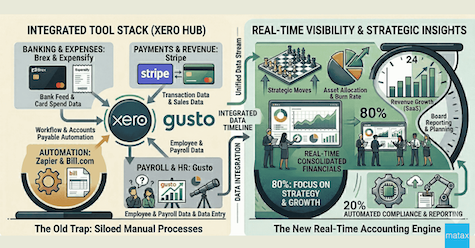
Data flows in from your tools instead of being typed in. When a Stripe payment clears, it posts to accounting.
When payroll runs in Gusto, the entries hit the books. When an expense is approved, it syncs over. Nobody is re-entering data that already exists somewhere else.
Invoices and receipts get processed without manual data entry. A tool like Dext reads your vendor invoices and creates the bill. Your team reviews and approves. It posts. No one typed anything.
The result: your books run mostly in the background. The person responsible for your accounting spends their time reviewing outputs, asking questions about unusual items, and doing the work that actually requires a human brain.
The Tech Stack Behind It
There's no single tool that does all of this. It's a connected set of tools, each handling one piece of the picture.
•Xero. Xero is where everything lands. Your accounting platform, your financial statements, your reconciliation. The key is setting it up correctly for how a SaaS company actually works: the right chart of accounts, bank feeds pulling daily, reconciliation rules that handle your most common transaction types automatically.
•Stripe. Connects to Xero to handle subscription revenue and payments. Not the default integration, which is too shallow for most SaaS companies. A properly configured connection that handles your billing model, fees, refunds, and deferred revenue the right way.
•Gusto or Rippling. For payroll. When payroll runs, the journal entries post to Xero automatically. Predictable, high-volume, and one of the easiest places to eliminate manual work immediately.
•Mercury, Brex, or Relay. Startup-friendly business banking that connects directly to Xero via bank feed, so your cash position is always current without anyone manually importing statements.
•Ramp or Brex. Connected to Xero so approved expenses post automatically, without expense reports traveling through three inboxes.
•Dext or Hubdoc. Invoices get captured, data gets extracted, bills get created in Xero. Your team approves. It posts.
•n8n, Zapier, or Make. For anything custom. Revenue recognition workflows, close checklists, approval routing, workflow optimization specific to how your business works. This is where the off-the-shelf tools run out, and the real automation starts.
What Actually Changes
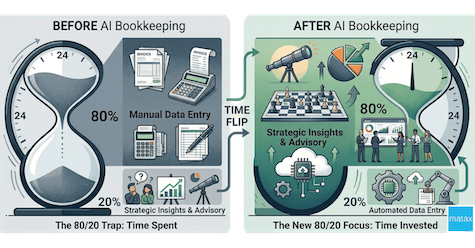
At seed stage, your finance person probably spends 80% of their time on bookkeeping: entering transactions, chasing receipts, reconciling accounts. Twenty percent on the strategic work.
With accounting automation in place, that flips. Most of the routine work runs automatically. Your team handles exceptions, reviews outputs, and spends the bulk of their time on forecasting, board reporting, and the decisions that actually affect the business. The operational efficiency gains show up within the first month.
Your board experience changes too. Financials in five business days instead of two weeks. Numbers your investors can trust because they're coming out of a documented, consistent process, not a heroic manual effort.
And when due diligence comes, you hand over a clean system. Not months of cleanup work. A documented process, accurate history, and records an auditor can follow from the first page.
How to Get There
If you've just closed Series A or you're raising now, this is the right moment to upgrade.
•Start with Xero. Get the chart of accounts right for your SaaS model. Get bank feeds connected. Set up reconciliation rules for your most common transaction types.
•Connect Stripe properly. Don't accept the default integration. Get someone who has built this before to configure how your subscription billing, fees, refunds, and deferred revenue actually flow into your accounting.
•Automate payroll. Connect Gusto or Rippling so entries post when payroll runs. This is high-volume and predictable. It should be automated immediately.
•Add expense and invoice capture. Connect your expense tool. Add Dext or Hubdoc for vendor invoices. This is where most of the remaining manual entry lives.
•Build custom workflows for what's specific to you. Revenue recognition automations. Close checklists. Reporting that gives your board exactly what they need.
MATAX handles the full build for Series A companies. Design, integrations, workflows, testing, training. The implementation typically runs four to eight weeks, depending on how complex your current setup is. The goal is a bookkeeping infrastructure that doesn't require a bigger team every time the business gets bigger.
Questions Founders Usually Ask
Does this replace our accountant or CFO?
No. It replaces the data entry and reconciliation, not the thinking. Revenue recognition decisions, board reporting, cash flow strategy, fundraising prep: those still require a human who understands accounting and knows your business. The automation handles the volume so your team can focus on the work that actually requires them.
How much does it cost?
It depends on the complexity of your current setup and how many integrations need to be built. The software costs are modest. Xero, your Stripe integration, Dext, n8n if you need custom workflows.
The investment is really in the implementation: designing the architecture, building the connections, testing everything, training your team. MATAX scopes this carefully before any engagement so there are no surprises.
Can we do this ourselves?
Some of it, yes. If you have someone on your team who is technically comfortable, they can set up Xero rules, connect basic integrations, get payroll automation running. The harder part is building the full integrated stack and making the right architecture decisions upfront.
The shortcuts that come from having done this before save time. The mistakes you avoid save more.
How long before we see results?
The fastest change is your monthly close. You'll see that within the first month. Within the first quarter, manual bookkeeping work typically drops by 70 to 80%.
Within six months, you have the operational infrastructure that holds up to Series B due diligence. The compounding effect grows over time as the quality of your data improves decision-making across the whole business.
What if our bookkeeper isn't ready for this?
Some bookkeepers love it. They never wanted to do data entry and they thrive with the strategic work automation opens up. Others find it's easier to move on.
MATAX works with whoever is handling your accounting to train them on the new workflows. We also work with external accounting firms and fractional CFOs who are already comfortable with modern infrastructure.
The Gaps We See Every Time
In every discovery engagement with a Series A company, the same three things show up.
• The Stripe integration is too shallow. The default Xero connection maps all revenue to one income account. Fees, refunds, and subscription events are handled incorrectly or not at all.
The monthly numbers look roughly right, but don't reconcile precisely to the bank statement and don't break down by product line. At low volume, this is annoying. At Series A volume, your board starts asking questions your reports can't answer.
•Deferred revenue is being done manually. Any SaaS company with meaningful annual prepay has a deferred revenue balance that needs to be unwound each month. When that's not automated, someone is calculating it by hand, which means it's either wrong or late. Investors preparing for due diligence notice this quickly.
•The close is taking too long. Series A companies with manual bookkeeping often close in ten to fifteen business days. That timeline creates friction with investors who want monthly reporting fast, and with boards making decisions on numbers that are already two weeks old by the time they arrive.
None of these are catastrophic when you're raising Series A. But they compound. The right time to fix them is before the complexity grows further.
What Investor-Grade Books Actually Means
The phrase gets used loosely. Here's what it means in practice.
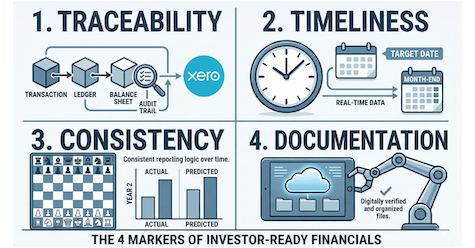
• Every number in every report traces back to underlying transactions. No unexplained differences, no entries labeled "miscellaneous," no plugged numbers that make the balance sheet balance without making sense.
• The most recent month is closed and available within five business days of month-end. Not last quarter. Not two weeks ago. Five days.
• Revenue is recognized the same way every month. Expense categories follow the same logic every period. A new analyst who didn't create the reports can understand how they work.
• The close process is written down. The chart of accounts structure has logic behind it that can be explained. The automation workflows are documented well enough that someone can maintain them without having built them.
That's what good accounting automation delivers at Series A. And that's exactly what investors are looking for when they open your data room.
The Real Reason This Matters Right Now
Fundraising is harder than it was two years ago. Founders I talk to are hearing "not yet" more than they expected. In that environment, the companies that do close their rounds are the ones that make it easy for investors to say yes.
Clean, current, auditable books don't make your product better. But they remove one of the most common reasons a term sheet doesn't get signed. Due diligence doesn't become a cleanup project.
Investor questions get answered the same day. The story your numbers tell matches the story you're pitching.
That's the real case for accounting automation at Series A. Not efficiency. Not saving time. The ability to raise when most people can't.
Dawn Hatch is the Founding Partner of MATAX, which designs, builds, and automates the operational infrastructure behind scaling startups. MATAX is San Francisco-based, a two-time Xero Partner of the Year, and Xero's 2025 Advisory Innovator of the Year.
