
The Accounting Consultant Test Founders Fail
Here's the test I'd give any accounting automation consultant before hiring them: ask them to walk you through exactly how they'd configure your Stripe-to-Xero integration given your specific billing model. Not a general answer. Your model. Annual prepays, monthly subscriptions, mid-cycle upgrades, all of it.
If they can answer that question with specificity, they've done the work. If they pivot to talking about their process, their team size, or their client list, they've sold it without doing it.
That single question separates the field faster than any amount of due diligence.
The benefits of accounting automation are real and measurable: faster financial reporting, cleaner financial data, less time spent on time consuming routine accounting tasks, and a financial management foundation that holds up under investor scrutiny. The challenge isn't understanding the benefits. It's finding consulting services that actually deliver them. Traditional accounting firms often bring accounting depth without automation capability. Pure tech consultants build fast but miss the accounting logic. The firms that do both well are the ones worth tracking down.
Why "Best" Is Harder to Find Than It Looks
Every firm in this space says the same things: we understand startups, we specialize in SaaS, we're automation-forward. The pitch is nearly identical across the board. That's because the pitch works, until you're six months in and realizing your Stripe data still doesn't match your Xero revenue.
Real differentiation in accounting automation consulting comes down to three things that are very hard to fake.
They've built systems for businesses with your revenue model. A SaaS company with annual prepays, usage-based billing, or multi-product subscriptions has accounting complexity that a generalist doesn't see coming. The edge cases, including mid-term upgrades, partial refunds, contract cancellations, and contract extensions, are where systems break. The consultants worth hiring have hit those edge cases before, on other clients' books, before they hit yours.
They build automation that actually holds. Not just "we connected Stripe to Xero." Every firm can click through a native integration setup. The differentiation is in whether they build the configuration that handles your specific flow correctly: fees split out from revenue, refunds categorized to the right accounts, deferred revenue unwinding monthly without manual recalculation. The difference between a shallow integration and a correct one doesn't show up on day one. It shows up in month six when someone notices the numbers don't quite reconcile.
They stay in the relationship. Automation breaks. APIs change. You launch a new product line. You move from monthly to annual billing. The consultant who builds your system and considers the engagement complete is providing a one-time service. The consultant who watches the system, catches problems before you do, and updates configurations when your business evolves is a long term partner. You want the second one.
The Firms Worth Knowing
MATAX (San Francisco)
I'm not going to pretend objectivity here. MATAX is my firm. What I can tell you is what we actually do: we build operational and accounting infrastructure for SaaS startups, exclusively. No restaurants, no retail, no general small business. Every engagement is a tech company on Xero, and we've been doing it since 2012. We're a two-time Xero Partner of the Year. Dawn Hatch, the author of this article, received Xero's 2025 Advisory Innovator of the Year award.
What we build isn't just bookkeeping. It's the connected infrastructure behind your books: Xero set up for your specific model, Stripe configured properly, payroll automated, accounts receivable tracked, corporate credit cards synced and categorized, and AI powered, machine learning-informed automations for the accounting tasks that off-the-shelf integrations don't handle cleanly. Our advisory services extend beyond the initial build. We maintain the systems, update configurations when your business changes, and watch for problems before you do. MATAX works with SaaS companies across the United States. Data security is built into every engagement: your financial data lives in controlled, audited systems, and we can walk through our practices clearly.
Kruze Consulting (San Francisco)
The name with the highest profile in the VC-backed startup ecosystem in SF. Kruze's strength is at the intersection of accounting and strategic advisory: tax strategy, financial modeling, CFO-level guidance for funded companies. If you're a Series A or B company that needs both accounting operations and meaningful strategic financial leadership, Kruze belongs on your shortlist.
Graphite Financial (Remote)
Fractional CFO and accounting services for venture-backed startups, with particular depth on the strategic financial side. Fundraising preparation, investor relations, board communication. Strong for Series A and B companies that need CFO horsepower alongside accounting operations.
Bookkeeper360 (Remote)
Solid Xero foundation, predictable packages, clear pricing. A product-forward bookkeeping service that works well for startups that want consistent, reliable service without extensive customization. If you're early-stage and want a clean setup without a complex engagement, Bookkeeper360 is worth considering.
How to Run the Evaluation
The pitch sounds similar across all of these firms. Here's how to see through it.
Ask for specificity, not generality. "Walk me through how you'd configure Stripe for a company with our billing model" produces a different answer than "tell me about your Stripe integration experience." Specificity reveals whether they've done the work.
Get a real close time number. Not "we're usually pretty fast." Ask for the median close time across clients at your stage. Under five business days is the target. If they can't answer with a number, the data isn't there.
Ask about a custom workflow they've built. Not an off-the-shelf integration, a custom automation. What was the problem, what tools did they use, what did it replace? A real answer will describe a specific client situation. A vague answer will describe a capability.
Find out what happens after implementation. Ask directly: "If my billing model changes in six months, what does that engagement look like?" A project-based firm will explain how they'd scope a new project. A partner will explain how they'd update the system as part of the relationship.
Call the references. Specifically, founders who have gone through a fundraising while working with this firm. Ask whether the diligence process was smooth or painful. Ask whether their accountant caught a problem before they did. That's the most revealing reference question you can ask.
What the Implementation Actually Looks Like
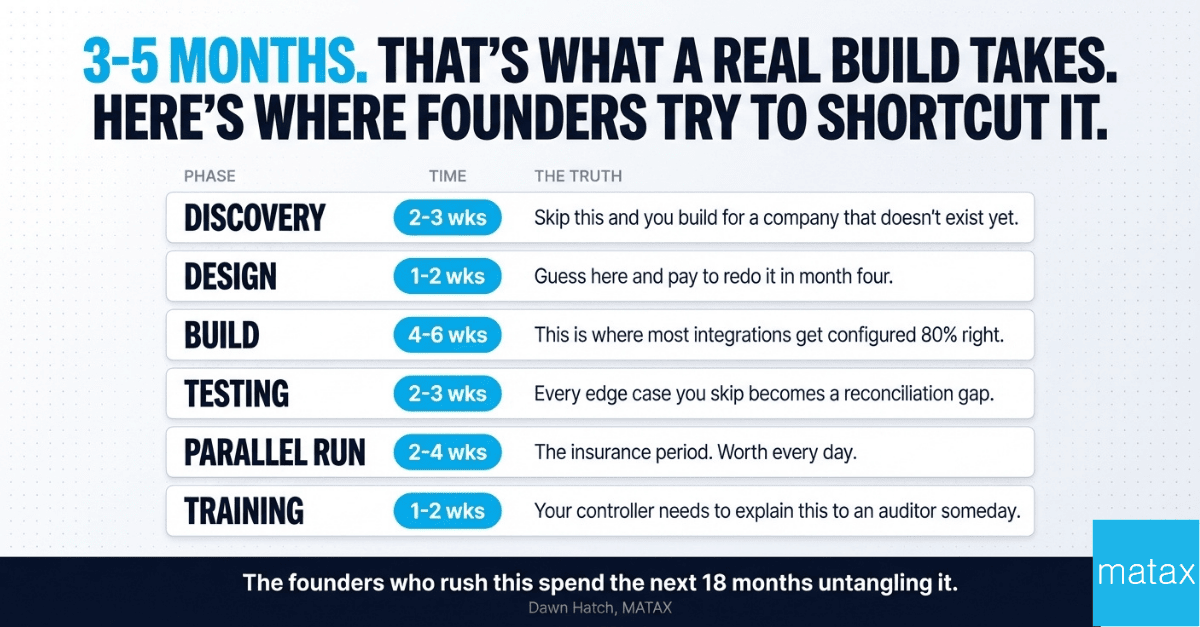
Founders who've never done a full accounting infrastructure build often underestimate what's involved. The goal is a configured accounting automation software stack that handles the mechanical work automatically, saving time across your finance teams and freeing them for judgment-level decisions, not data entry. Here's the honest timeline.
Discovery (2-3 weeks). Mapping your current setup, understanding your revenue model, cataloging your tech stack, and documenting every accounting-specific requirement. This phase is where misalignment surfaces. Skip it and you pay for it in rework later. A thorough discovery means the consultant understands your business before they touch a tool.
Design (1-2 weeks). The consultant presents the full architecture: Xero chart of accounts structure, which integrations need configuration, which workflows need to be custom-built, and the reasoning behind each decision. You should be able to understand this document without technical background. If you can't, ask them to explain it differently. Clarity is a feature, not a nice-to-have.
Build (4-6 weeks). Revenue configuration, payroll integration, expense management, document capture, custom workflows, all running in parallel, with integration points checked continuously. Good consultants build in test environments and validate outputs before touching production data.
Testing (2-3 weeks). Every edge case your business throws at the system, tested before go-live. Standard monthly renewal. Customer who upgrades on day ten. Refund on an annual contract. Customer who churns with a month left on their term. These aren't hypothetical. They're what real customers do. Test them in the sandbox.
Parallel run and cutover (2-4 weeks). Running the new system alongside the old one until everyone is confident. Then cutting over. This is the insurance period, and it's worth the time.
Training and documentation (1-2 weeks). Not optional. Your controller needs to be able to explain the system to an auditor. Your ops lead needs to know how to troubleshoot common issues. Documentation should exist at multiple levels: technical detail for your accountant, plain-language overview for everyone else.
Total timeline: three to five months for most SaaS companies. Simpler setups faster. Multi-entity companies with complex billing models slower.
The Mistakes That Derail Implementation
These come up often enough that they're worth naming directly.
Rushing discovery. Founders who want to move fast often push to skip or compress the discovery phase. This creates a build that reflects what the consultant assumed your business does, not what it actually does. The misalignment shows up later, in reconciliation gaps and edge cases that the system doesn't handle correctly.
Treating it as a project, not a relationship. The question to ask before signing any engagement: what's included after go-live? If the answer is "support tickets," that's a project engagement. If the answer describes ongoing maintenance, system monitoring, and how the relationship works when your business changes, that's a partnership. Know which one you're buying.
Skipping edge case testing. Standard transactions are easy. It's the non-standard ones, the partial refunds, the mid-cycle changes, the customer who pays differently than everyone else, where automation fails in production. Insist on testing these before launch. The consultant should have a defined edge case testing protocol, not just a general QA process.
Delegating without understanding. You don't need to be technical, but you need to understand what the system is doing and why. If your consultant can't explain the design in business terms, that's a red flag. Good consultants can describe what they've built at multiple levels of detail. If yours can't, you won't be able to maintain it when they're not available.
The Infrastructure Advantage That Compounds
Here's what founders don't fully appreciate until they're in it: the accounting infrastructure you build now determines how your next fundraise feels.
A founder who opens a Series A data room with audit-ready books, where the financial reporting is consistent and complete, where every report answers the question it's supposed to answer, where the financial data reconciles back to day one, where the revenue recognition methodology is documented and defensible, projects something. Operational maturity. The sense that this team knows how to build a company, not just a product.
The founder who walks into diligence with a two-week close and books that are two months behind projects something different.
The same infrastructure difference that saved you hours every month is the same one that gets your diligence done in three weeks instead of three months.
Find the consultant who can build that. Give them the billing model test. Check the references. Get a real close time number.
The right one is worth the time it takes to find them.
Frequently Asked Questions
How do I know if an accounting automation consultant has genuine SaaS expertise?
Ask them to walk through exactly how they'd configure your specific billing model, not a general setup. A consultant with real SaaS experience will describe specific configuration decisions for annual prepays, usage-based components, and mid-cycle upgrades. Vague answers about process or team size suggest sales experience, not implementation experience.
What's the difference between an accounting automation consultant and a bookkeeper?
A bookkeeper maintains the records. An accounting automation consultant designs and builds the systems that make maintenance efficient or nearly automatic. The bookkeeper's job is reconciliation and review. The consultant's job is eliminating the manual reconciliation work. For a SaaS startup, the consultant's work typically comes first, then the bookkeeper maintains what was built.
Can a pre-seed company benefit from accounting automation consulting?
Yes, particularly for getting the Xero chart of accounts and Stripe integration right from the start. The cost of building correctly at pre-seed is lower than the cost of fixing a broken setup before Series A. The infrastructure doesn't need to be complex at this stage, but it does need to be right.
What should I ask in reference calls with an accounting automation consultant?
Ask founders who've gone through a fundraise: was the diligence process smooth? Ask whether the consultant caught any problems before the founder noticed them. Ask whether the close timeline improved during the engagement. The most revealing question is whether the consultant's work changed how the company runs, or just maintained what was already there.
How does a good consultant handle it when your business model changes?
A good one treats it as part of the ongoing relationship: when your billing model changes, they update the system. A project-based firm will scope a new engagement. Know which model you're getting before you sign. If you anticipate significant changes in your first 12 months, a partner model is meaningfully better than a project-based one.
What are the warning signs that an automation consultant isn't the right fit?
Vague answers to technical questions about your specific billing model. No documented examples of custom automation they've built. No specific answer to what their median close time is across clients. A close time over ten business days. No clear explanation of what maintenance looks like after go-live. Any of these warrant a second look at other options.
Dawn Hatch is the Founding Partner of MATAX, a San Francisco-based firm that builds operational infrastructure, accounting systems, and AI-powered workflows for scaling startups. MATAX is a two-time Xero Partner of the Year and Xero's 2025 Advisory Innovator of the Year.
