
Is the AI in your Startup Accounting under control?
A Q4 CoreOps checkup
By Dawn Hatch, Founding Partner, MATAX
Probably not yet, and you're in good company. Most accounting teams use AI now, but very few have written rules for it. Four questions close that gap: who owns each AI task, what it can touch, how you know it works, and how you stop it. You can finish a first pass before year-end.
Think about the question every founder dreads during Series A diligence: who approved that revenue entry from October? If nobody in your company can answer with real confidence, you have a governance gap. At MATAX, governance is the human control that sits on top of your accounting and your automation, and this checkup tests it in about an hour.
Here's how the gap opens up. A founder pastes a Stripe export into ChatGPT to categorize the transactions. A bookkeeper switches on an AI feature in a spend app. An operations lead builds an n8n automation that drafts invoices. Each one saves a meaningful amount of time, and almost none of it is documented anywhere.
Your own use is often the least documented of all, because a chat session leaves no record of which numbers went in or who reviewed what came out.
Can you pass this 60-second checkup?
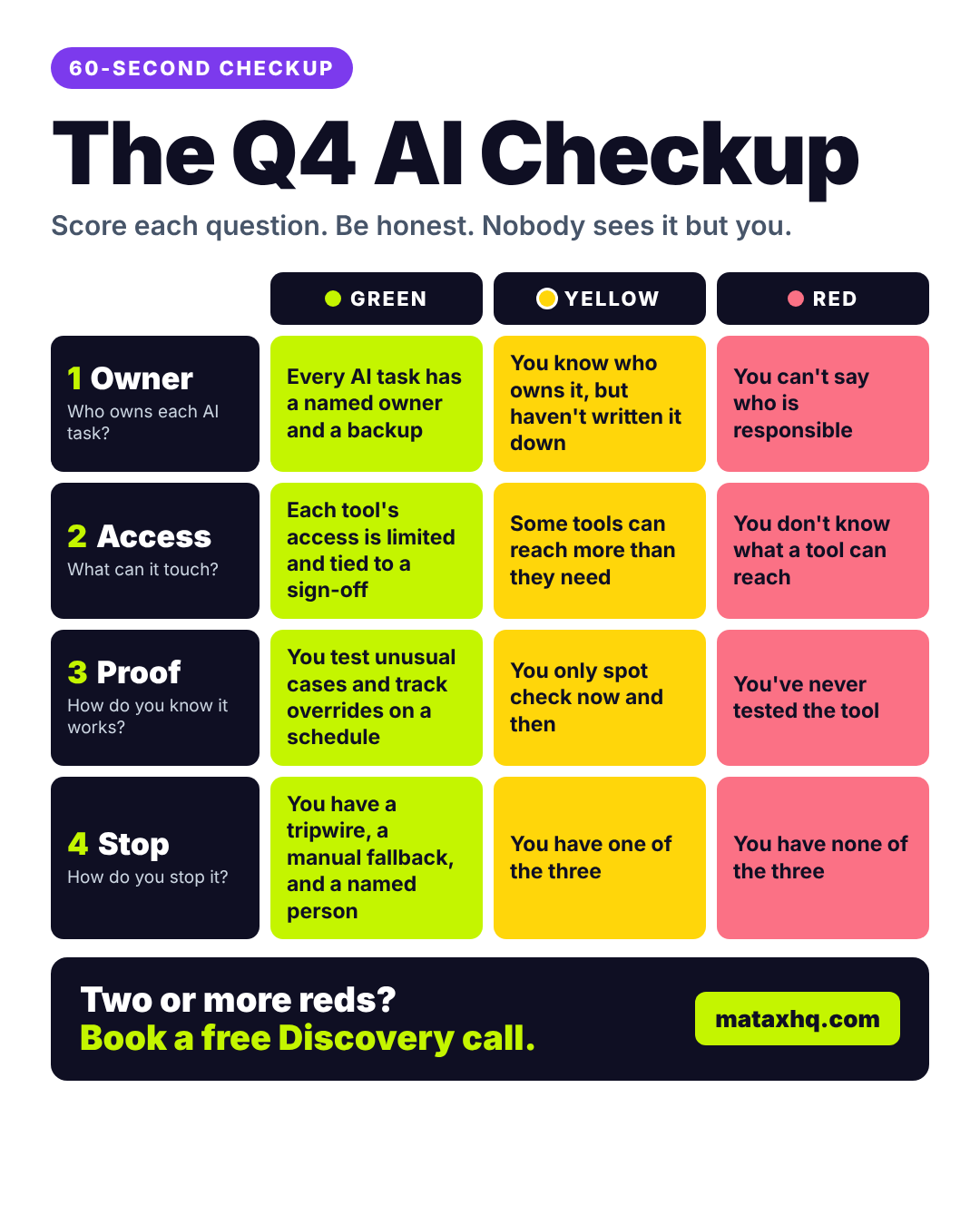
Score each of the four questions green, yellow, or red, and be completely honest with yourself, because nobody sees your score but you.
Start with owner. You're green if every AI task has a named owner and a backup, and red if you can't say who is responsible. Next is access. Green means each tool's access is limited and tied to a sign-off, while red means you don't know what a tool can reach.
Then comes proof. Green means you test unusual cases and track overrides on a schedule, and red means you've never tested the technology. Last is stop. Green means you have a tripwire, a manual fallback, and a named person, and red means you have none of the three.
Score each of the four questions green, yellow, or red, and be completely honest with yourself, because nobody sees your score but you.
Start with owner. You're green if every AI task has a named owner and a backup, and red if you can't say who is responsible. Next is access. Green means each tool's access is limited and tied to a sign-off, while red means you don't know what a tool can reach.
Then comes proof. Green means you test unusual cases and track overrides on a schedule, and red means you've never tested the technology. Last is stop. Green means you have a tripwire, a manual fallback, and a named person, and red means you have none of the three.
Yellow means you're partway there. You may know the answer but haven't documented it, or you only spot-check now and then. A couple of yellows is a normal place to be a few months into using AI, so treat them as a to-do list.
Two or more reds? That's the call to book. A free Discovery call is where we look at it together.
A checklist shows you where the gaps are, but closing them is a different job. Reds on access and stop usually mean building limits and tripwires into your accounting system and your workflows, which takes someone who has done it before. That's the part we handle: we design it, we build it, and your team owns it.
Why does Q4 matter for AI in your books?
Because year-end turns every loose process into a hard deadline for the whole organization. Your close, audit preparation, tax filing, and investor updates all pull from the same books, so any AI that touches them will eventually be questioned by someone outside your company.
The gap between everyday use and actual oversight is remarkably wide. Karbon's January 2026 report, based on nearly 600 accounting professionals, found that 98% of firms use AI, while only 21% have an AI policy or strategy. Financial Cents surveyed 486 bookkeeping and accounting professionals between July 15 and August 7, 2026. Among the firms using AI, 87% had no formal written policy, and only 20% reported clear, measurable ROI.
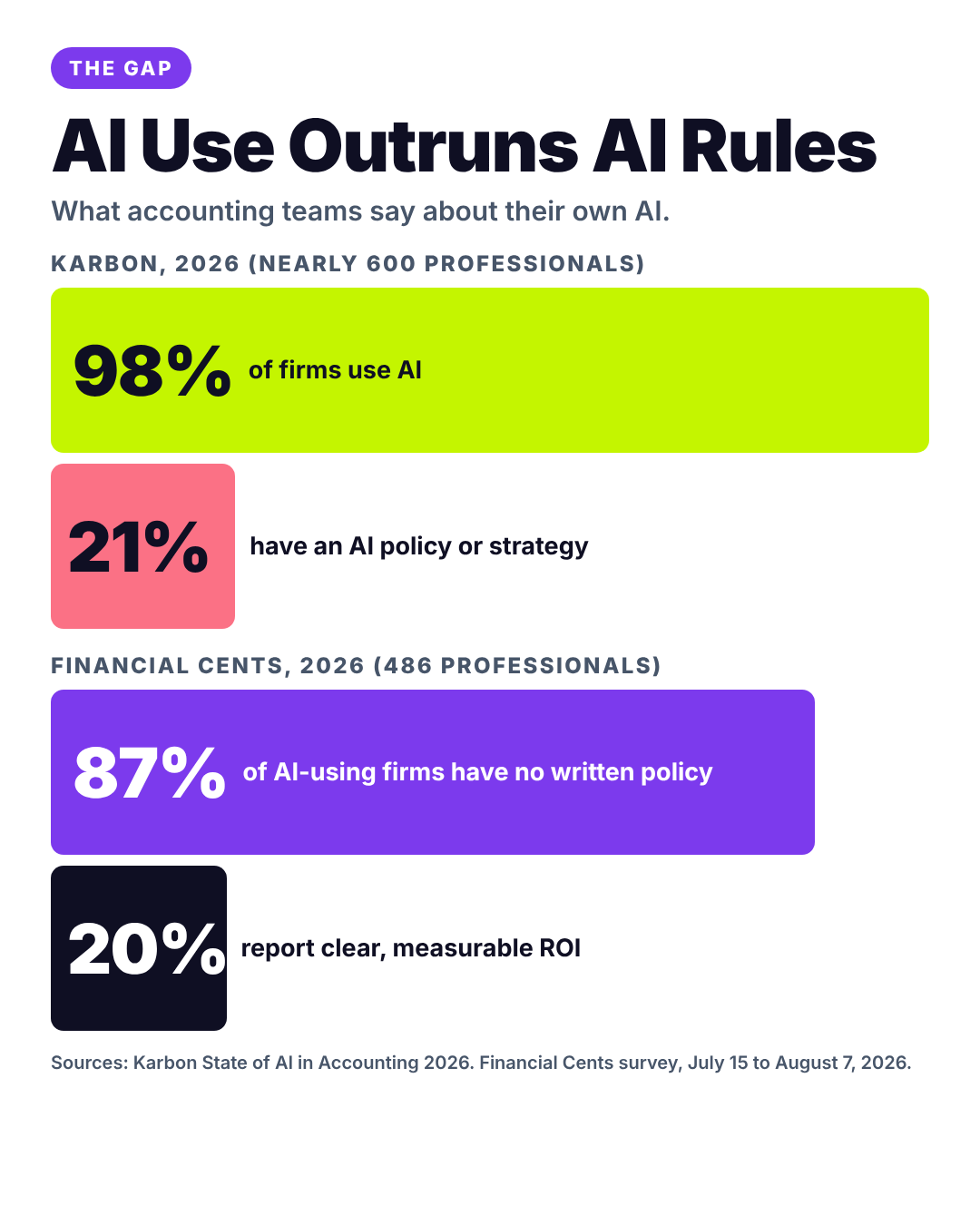
So the odds are good that the people handling your startup accounting sit in that 87%. That isn't a criticism of your accountant, because it's simply where the entire profession stands right now, and the founders who document their processes early will have a real advantage when investor diligence begins.
COSO, the group behind a widely used internal control framework, published guidance on generative AI in February 2026. Its message is direct: "set-and-forget" does not work. The four questions in this post draw on that guidance and on risk management practices that larger companies already follow, and the rule that nothing ships without someone's name on it is our own operating principle, not an industry standard.
Who owns each AI task in your books?
One named person owns each task, and that person should never be a whole team, a department called "finance," or the tool itself, because shared responsibility usually turns into no responsibility at all.
Start with a simple inventory of every tool and automation that touches your accounting, and for each one write down the task, the tool, the owner, and a backup. Most founders find five to ten items within an hour, including a few that nobody remembers approving and a few that were never reviewed by anyone.
The agent that drafts a record should never be the one that approves it, and if you can't point to the name next to a task, you've found your first gap, which is usually the easiest one to close.
Here's what an unowned task can cost. Picture a 14-person SaaS startup in April 2025. Its accounting AI codes a $48,000 annual engineering software contract as an April marketing expense, and nobody reviews the entry before it flows into the marketing budget and a fundraising deck. The contract should have been spread over twelve months, so only $4,000 belonged in April.
The budget now shows marketing $44,000 over where it should be, and the deck overstates April's operating loss by $44,000. A prospective investor questions the spending spike and passes on a $1 million seed allocation. A June review catches the error, but the allocation is gone.
This is an illustration, not a real company. The real error is a $44,000 overstatement of April's loss. The $1 million is a funding opportunity that slipped away, not a loss on the books.
What does the AI touch in your books?
Find out whether each tool can only read your financial data or is also able to change it. A tool that summarizes last month's spending carries little risk. A tool that can release a payment carries a great deal.
Drafting an invoice and authorizing a payment are very different responsibilities, even when a single tool is capable of both, so give every tool the least access it needs and then match the level of sign-off to the level of risk.
Think of access in four levels, from lowest risk to highest. A tool that only reads, like one that summarizes last month’s spending, needs the owner to check the summary. A tool that drafts, like an invoice or a journal entry, needs a person to approve it before it posts.
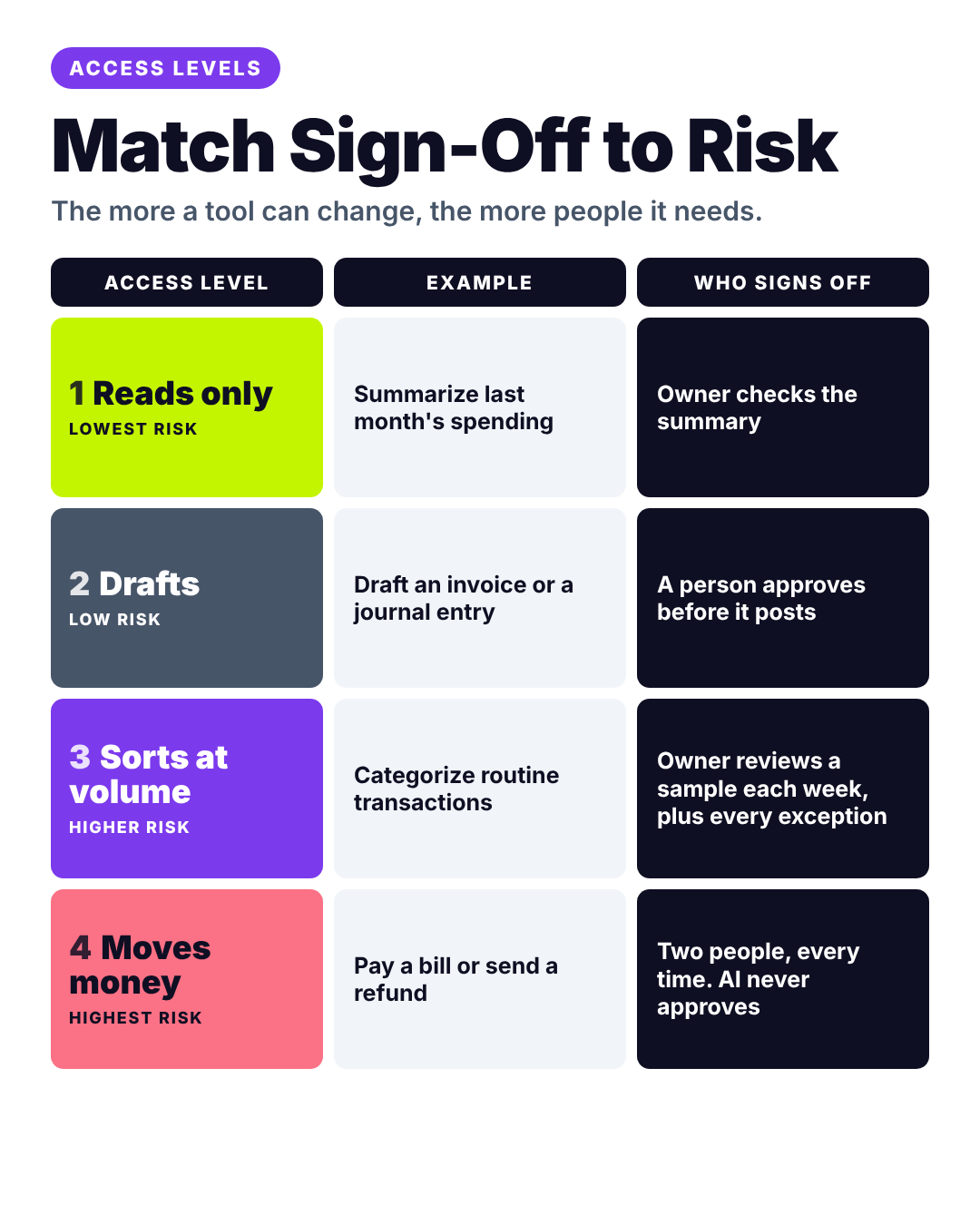
A tool that sorts at volume, like one that categorizes routine transactions, needs the owner to review a sample each week, plus every exception. A tool that moves money, like one that pays a bill or sends a refund, needs two people every time. AI never approves.
Notice that nothing here posts to your books on its own, which is deliberate, because the speed of automation only matters when you can trust the result that comes out of it.
How do you know the AI is doing it right?
You test it on unusual cases before you rely on it, and you keep testing while it runs. A tool that handles ninety-five routine transactions correctly can still fumble the five that matter to your investors.
Build a small collection of tricky examples and run them through the system every few months, ideally on a calendar reminder that belongs to the named owner.
Good examples to include are a customer refund, a payment received in another currency, a split payment, a vendor that appears under two names, and a bill dated December 31 for a service delivered in January. If the tool handles one incorrectly, you want to learn that during a test and not in the middle of a board meeting.
Then watch the trend lines. COSO suggests tracking indicators such as transaction volume, transaction size, and how often people override the AI. If overrides jump from 3% to 30% in a month, something has drifted. If they fall to zero, nobody may be reviewing anything.
Any AI output that could change a material amount in your books or your disclosures needs a human check before it counts, and that requirement is the dividing line between a useful assistant and a genuine financial risk.
How do you stop it when it goes wrong?
You decide how before it happens, which means every AI workflow needs a tripwire, a manual fallback, and a named person who understands exactly how to switch it off.
A tripwire is a rule that pauses the work and alerts a human, and it might fire when a single entry passes a set dollar amount, when transaction volume doubles overnight, or when a vendor appears that you have never paid before. A manual fallback is a written way to finish the same task by hand, so your team doesn't have to invent a process on the last day of close.
Finally, write down who gets called, how the books get corrected, and who communicates with your investors or your outside accountant when an error affects a filing or a report.
What should you ask your accountant about their AI?
Ask them to describe, in plain language, where their team uses artificial intelligence on your financial records and who reviews the results before anything is recorded. A good firm answers quickly and specifically, while a hesitant answer tells you the documentation probably doesn't exist yet.
Three follow-up questions are worth asking. Which of my transactions are categorized automatically, and how often is a sample checked for accuracy? What happens when the system disagrees with a person, and who makes the final decision? Where is my information stored, and which outside vendors are able to see it?
Keep the answers in a shared folder, so that the first time an investor or an auditor asks, you can respond in minutes instead of weeks.
FAQ
What is a CoreOps checkup? It's a short review of how AI and automation touch your books, scored on four questions: owner, access, proof, and stop. It tests the governance layer of CoreOps, which is the human control and accountability that sits on top of your accounting and automation, and you can complete a first pass yourself in a single afternoon.
Do I need an AI policy as a startup? Yes, but it can be short, and one page is enough to start. List each tool, what it is allowed to do, who owns it, and who signs off on its work, because a simple written page that exists is worth far more than a perfect policy that you never finish.
Who should review AI-prepared books? A person who understands the accounting as well as the technology, such as your controller, your outside accountant, or an experienced bookkeeper. The reviewer should never be the same person, or the same tool, that prepared the entry, because independent review is the whole point of the control.
What happens on a Discovery call? It's a free conversation before any paid work begins.
You tell us how your books, tools, and AI use run today. We tell you honestly where the biggest gaps are and whether a paid Diagnostic is the right next step.
Nothing is sold on the call, and the Discovery call always comes first.
Closing
This week, spend one focused hour on the list: every tool or automation that touches your books, the person responsible for each one, and a color for each of the four questions in the checkup above.
If you'd like a second set of eyes, book a free Discovery call at mataxhq.com. You tell us how your books and tools run today. You leave with a straight answer on where you stand, the gaps that matter most, and whether a paid Diagnostic makes sense. If it doesn't, we'll say so.
About MATAX
MATAX is an AI-native accounting and back-office firm for startups, based in San Francisco. We design and build the accounting and automation systems startups grow on, and your team owns them.
Founded in 2006 and 100% Xero since 2012, MATAX has worked with hundreds of startups, from pre-revenue to Series B. Xero Advisory Innovator of the Year 2025 and 2026. 2026 Xero AI Efficiency Champion. Start a conversation at mataxhq.com.
About the Author
Dawn Hatch is the Founding Partner and CEO of MATAX. She works with founders on the accounting and operating systems their startups use. She writes about the real work behind a startup's back office.
