
Bookkeeping vs Advisory in Startup Accounting
Clean books will not save you from a bad decision. They will document it accurately, which founders often discover is a different service than the one they thought they were buying. Bookkeeping is the record of what your business already did. Advisory is someone reading that record early enough to change what happens next.
A founder told me something last month that I have not stopped thinking about. Her books were spotless.
Reconciled to the penny, reports accurate, close finished two days early. She was also miserable. My accounting is perfect, she said, and I still keep learning about things after they have already cost me money.
Her bookkeeping was excellent, so the problem lived somewhere else. At a seed-stage or Series A company, her gap often appears in decisions made without one key detail. That detail would have changed them.
What is the difference between bookkeeping and advisory?
Bookkeeping is a record of what already happened. Advisory is an informed interpretation of that record.
Both matter, and the order matters too. Useful advisory needs clean books underneath it, which is why firms selling advisory on a messy general ledger tend to disappoint. Accuracy will confirm that a number is correct. It holds no opinion on whether that number should worry you.
The split, row by row.
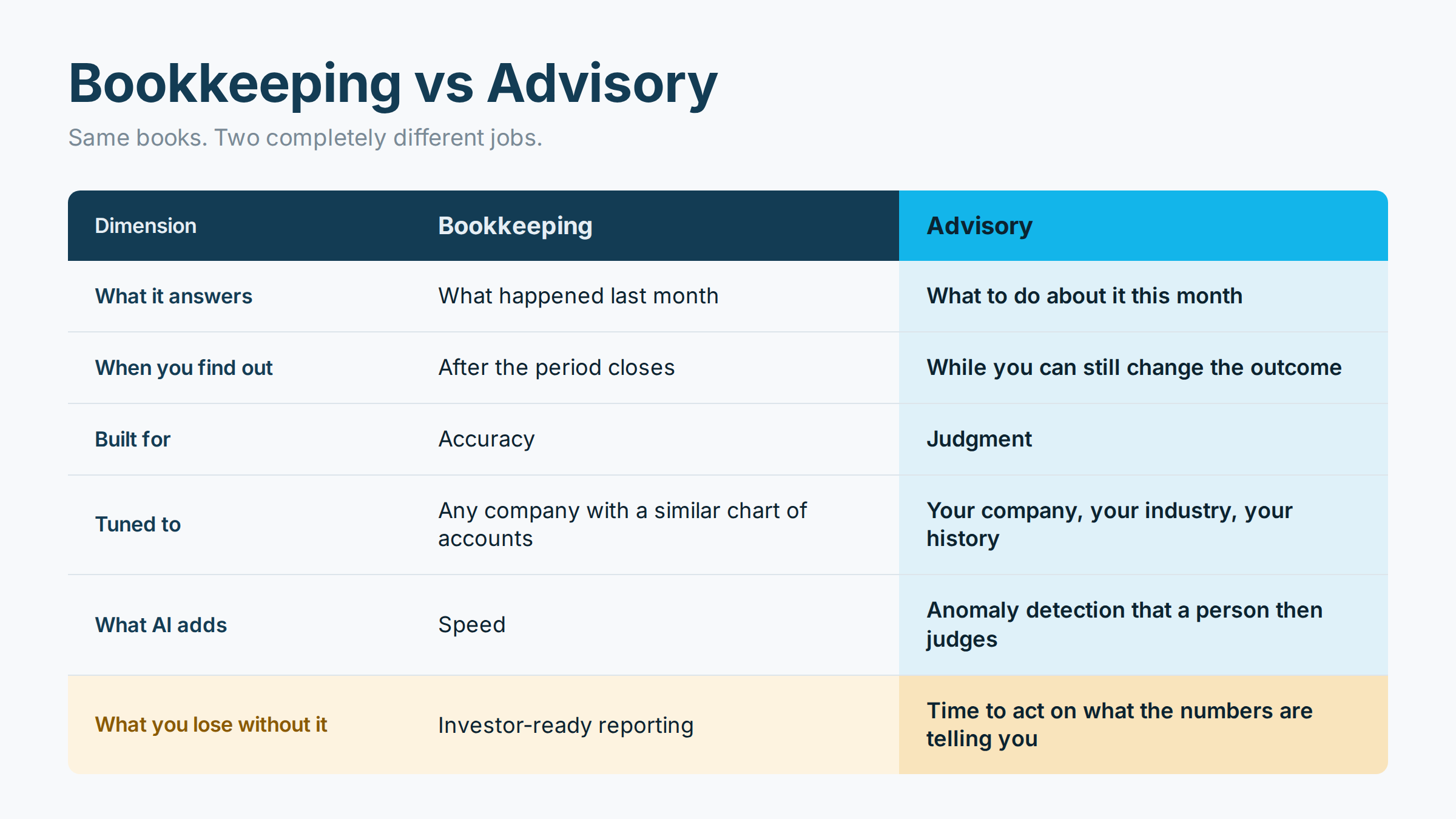
That last row is the one that costs founders money. Weak bookkeeping will stop a raise cold, so it gets fixed. Missing advisory lets you close the round and walk into the next quarter blind, and almost nobody treats that as urgent until it has already happened twice.
Why does so much AI advisory turn out to be faster bookkeeping?
The incentive shows up plainly in the survey data. In the 2024 CPA.com and AICPA PCPS Client Advisory Services Benchmark Survey, the 206 participating US firms reported median advisory revenue growth of 17 percent, and they projected a median increase of 99 percent over the following three years. Advisory is the fastest-growing service line in public accounting. Every firm now has a commercial reason to call whatever it already does advisory.
The speed itself is a real gain, and nobody who has it is giving it back. A tool that reconciles transactions in seconds rather than hours changes what a team can carry. Business automation of that kind is why a small accounting team now handles a roster that once took three times the headcount.
What speed does not produce is judgment, and judgment is the part a founder is actually paying for.
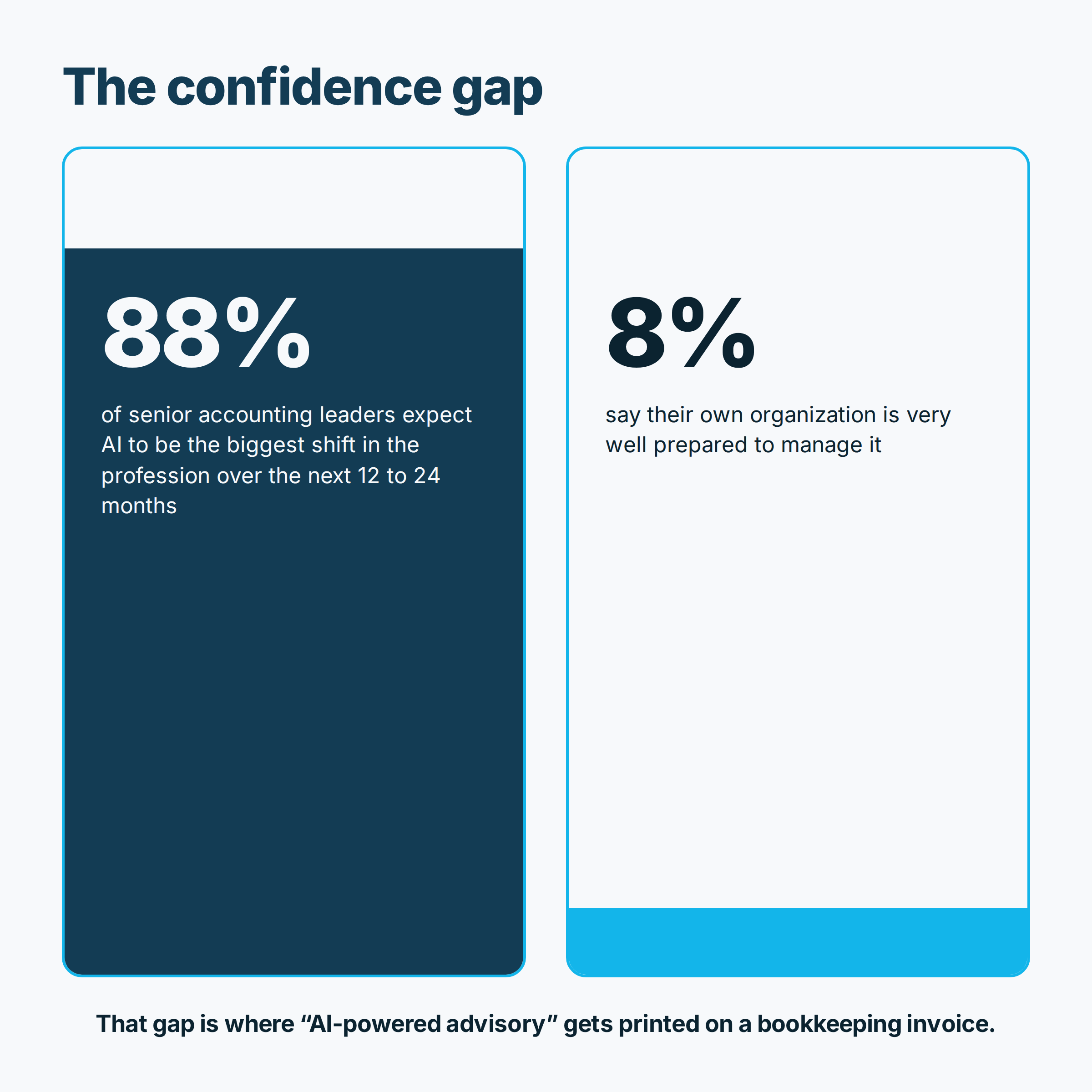
The readiness data points the same way. In the AICPA and CIMA Technology, Productivity, and Skills survey published in December 2025, 88 percent of the 1,446 senior accounting leaders surveyed expect AI to be the biggest technology shift in the profession over the next 12 to 24 months. Only 8 percent described their own organization as very well prepared for it. A profession that confident about the direction and that unsure of its own footing will reach for the label before it has finished building the thing.
Across the more than 800 US startups we have worked alongside, the pattern repeats. A firm adopts a strong AI automation stack, halves its production time, and starts calling the output advisory on the grounds that it arrives sooner. Arriving sooner is worth something. It still tells you nothing about your business that you did not already have.
Try this test. If the tool doubled its speed tomorrow, would you learn anything you did not already know? A no means you are looking at operational efficiency, which belongs on the firm's side of the ledger rather than the advisory line of your invoice.
What does advisory look like when it is built for one company?
Advisory that holds up under pressure looks nothing like one dashboard cloned across a roster.
It is a setup that knows one company well. Its industry.
Its transaction history. The gap between how its founder describes a problem and how an accountant would write it up. A tool spread evenly across a hundred clients will move fast, and it will still miss anything true and specific about any one of them, because nobody built it to look that closely at a single company.
We built ours the other way around. Every client gets a setup of their own, configured against that client's books, history, and industry.
It reads what comes in and measures it against that company's own baseline. Anything unusual goes to a person on our team first. Nothing reaches the client's numbers before somebody has looked at it.
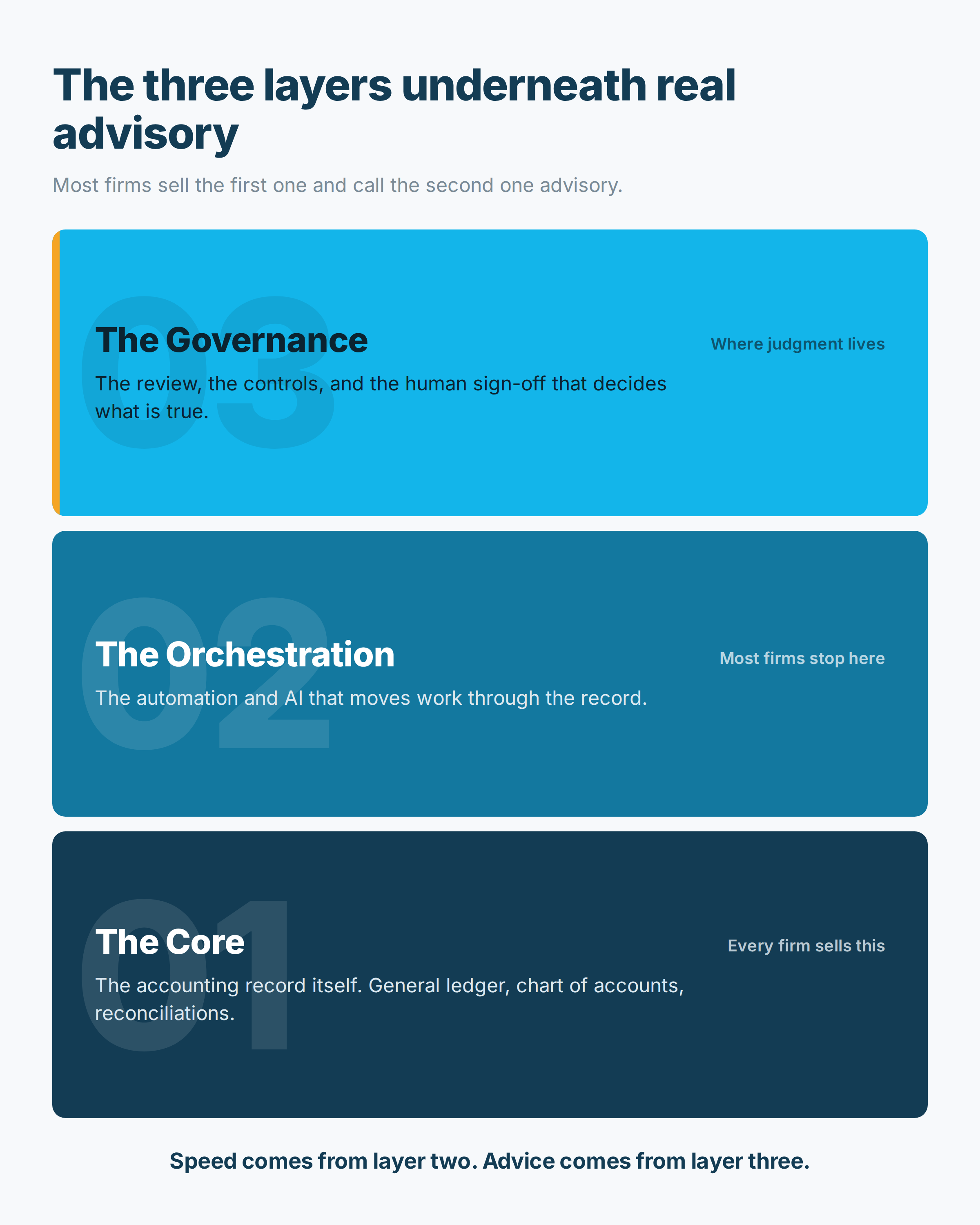
That setup sits inside the framework we call MATAX™ CoreOps, which sorts everything we deliver into three layers. The Core is the accounting record itself: general ledger, chart of accounts, and the reconciliations underneath them. The Orchestration is the automation and AI that moves work through that record. The Governance is the review, the controls, and the human sign-off that settles what is true before anything reaches you.
Most firms sell the first layer and market the second one as advisory. Judgment lives in the third.
Back to the founder from the opening. She used to notice a drifting expense category weeks later, during a monthly review, after it shaped the decision. Now it gets flagged in the week it drifts, and she sees it before the review starts.
Nothing about her business got simpler. She just stopped finding things out too late to do anything about them.
How do you know someone tested an accounting system before it touched your books?
You ask, and a good answer will be specific about the testing.
None of this happened overnight. Every system we built ran in parallel with one of our accountants for months. It was checked line by line against a version made by hand. Only then did it touch a real client’s books. We wanted to be certain before asking a founder to be.
This matters more than it sounds. An AI workflow that is 97 percent accurate can demo well. It can be a serious liability in a general ledger. The other 3 percent may hit accounts nobody questions. That can change when an investor or auditor reviews them. The only reliable way to find those errors is to run both versions side by side long enough for the disagreements to surface.
We have been building these systems since 2023, on top of a practice running entirely on Xero since 2012. The AI part is newer than the accounting part on purpose. Solid Xero accounting services and tidy back office operations came first.
Why do the AI and advisory awards only count together?
On August 20, 2026, Xero named MATAX both AI Efficiency Champion and Advisory Innovator of the Year in its US Partner Awards, two of eight trophies across the US accounting and bookkeeping categories. Advisory Innovator was a back-to-back win, following the same award in 2025. AI Efficiency Champion was new that year, created to recognize practical and responsible AI use with Xero at the center of the workflow.
Two categories, one point. AI Efficiency Champion was for the system that clears repetitive production work quickly and accurately: document processing, transaction coding, and reconciliation. Advisory Innovator was for what a firm does with the time that system frees up.
Neither award means much on its own. A fast system without judgment is automation, no matter how it is marketed.
Judgment without a system to clear the noise will not scale beyond a few clients. Together they answer one question: does a founder end up with a clearer picture of their business, or just a faster one?
The awards do not change what we do on a Tuesday. They confirm, from outside our own walls, that the distinction holds up when someone else examines it closely.
What should you ask any accounting partner before you sign?
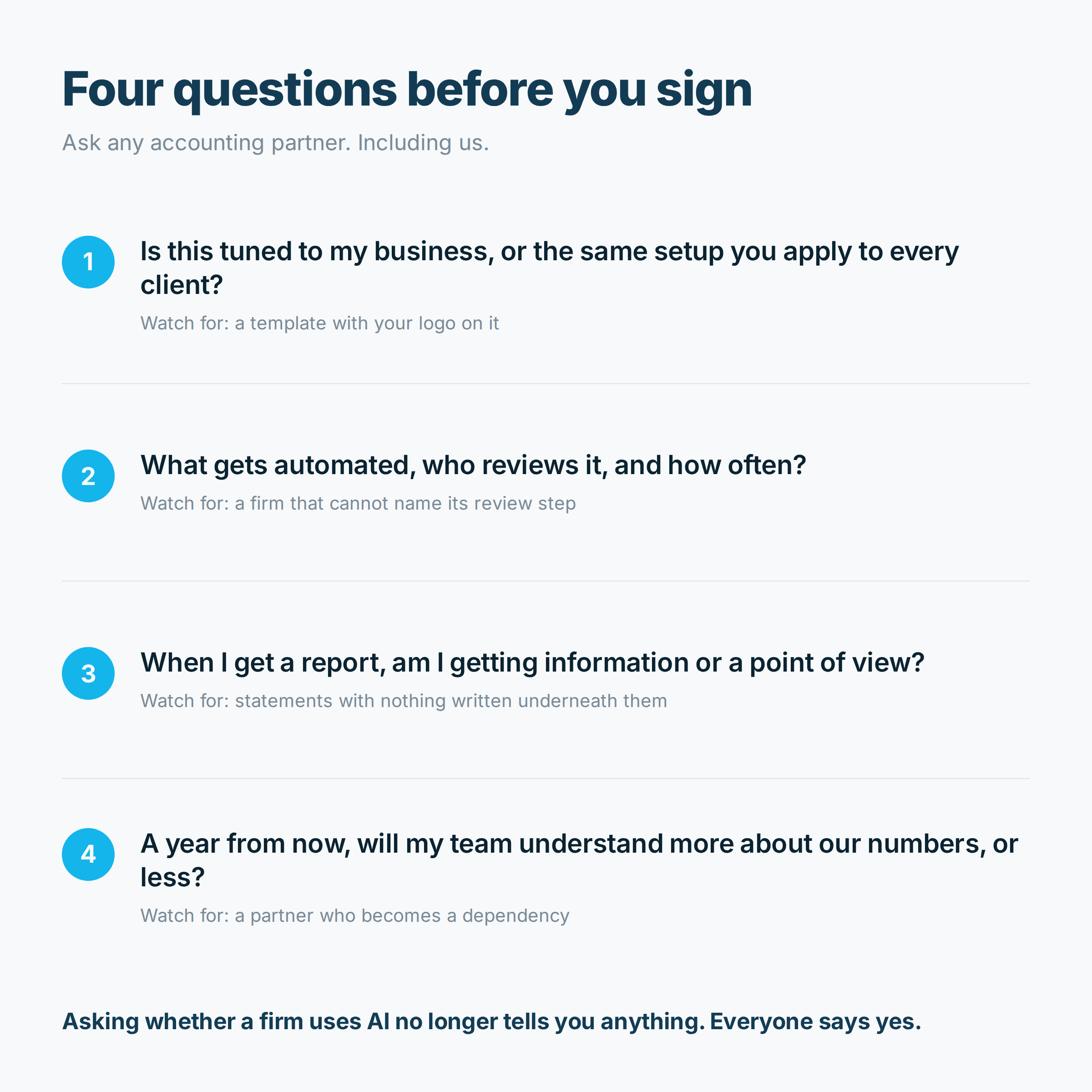
You do not have to take anyone's word for which one they are selling. Four questions on a first call will tell you. Ask them of us, and of every other firm you are considering.
Is this tuned to my business, or is it the same setup you apply to every client? Ask what specifically gets configured for you. If the honest answer is a template with your logo on it, you are buying bookkeeping.
What gets automated, who reviews it, and how often? A firm that cannot name its review step does not have one. Ask what happens when the automation disagrees with the accountant.
When I receive a report, am I getting information or a point of view? Ask for a redacted sample and look for whether anyone wrote down what the numbers mean and what they would do about it.
A year from now, will my team understand more about our numbers than on day one, or less? Most founders skip this one, and it separates a genuine partner from a dependency. Good advisory makes your own team more capable, not more reliant on the firm.
Those four are a better filter than asking whether a firm uses AI. Everyone says yes to that now. It has stopped meaning anything.
What can you do this week to tell the two apart?
Four things, none of which require hiring anyone.
Pull your last three monthly reporting packages and look for a written explanation of any meaningful variance. No narrative means you are receiving bookkeeping.
Time your close honestly. Write down the date your books actually locked, not the date they were meant to. APQC benchmarking across roughly 2,300 organizations puts the median close cycle at about 6.4 calendar days, the top quartile at 4.8 days or fewer, and the bottom quartile at 10 days or more. The businesses we work with, from pre-revenue to Series A, often see a gap.
It can be several days between the claim date and the lock date.
Take your last expense surprise and trace when it first showed up in your accounting system versus when someone told you about it. That interval is the number that matters.
Ask someone on your team who is not your accountant to explain your gross margin trend. If they cannot, that knowledge lives outside your business.
FAQ
What is the difference between bookkeeping and advisory for a startup or SMB?
Bookkeeping produces an accurate record of what already happened. Advisory interprets that record and recommends what to do next. For a startup or SMB, that is the gap between a clean monthly reporting package and that same package plus a written read on burn, margin drift, and the two line items that changed shape. Only one of them changes a decision.
Does a pre-revenue startup need advisory, or just bookkeeping?
Pre-revenue startups get more out of advisory than most people expect, because each choice is huge next to the numbers involved. On twelve months of runway, a spending pattern that drifts for two quarters becomes a real problem. If your books are not clean yet, fix that first. Advisory built on an unreliable general ledger produces confident answers to the wrong question.
Can AI actually do advisory work, or only bookkeeping?
AI is very good at the parts that scale: reading documents, coding transactions, reconciling accounts, and flagging entries that look odd against a company's own history. That is genuine production work. The judgment step, deciding whether an odd entry matters and what to do about it, still belongs to a person. Setups that work pair the two rather than pretending the first is the second.
How do I know if I am paying for advisory and receiving bookkeeping?
Look at what arrives every month. Statements with no written read and no advice attached are bookkeeping, whatever the engagement letter calls it. Another quick check: count how many times last quarter your accounting partner told you something before you asked. Zero means the relationship is reactive, not advisory.
What should a startup fix first, its accounting setup or its automation?
The accounting setup, in almost every situation. Automating a broken process just makes it break faster and in more places at once.
Get the chart of accounts, the bank feeds, and the close checklist into decent shape, then automate the repetitive parts. Teams that work in that order get the increased productivity they were after. Teams that reverse it rebuild twice.
Closing
If you are staring at your own numbers wondering whether you have advisory or just faster bookkeeping, the four questions above will settle it in about ten minutes.
We built the practice this way because it works for the founders we work with, well before any awards were attached to it. Happy to walk through what the difference looks like in your own setup if that would help.
Sources
CPA.com and AICPA PCPS Client Advisory Services Benchmark Survey, December 2024.
AICPA and CIMA, Technology, Productivity, and Skills Survey, December 2025.
About the author
Dawn Hatch is Founding Partner and CEO of MATAX, the San Francisco firm she founded in 2006. She has helped more than 800 US startups and growing businesses build accounting and automation systems their own teams can run. Her firm is a two-time Xero Partner of the Year, back-to-back Advisory Innovator of the Year, and the 2026 AI Efficiency Champion.
